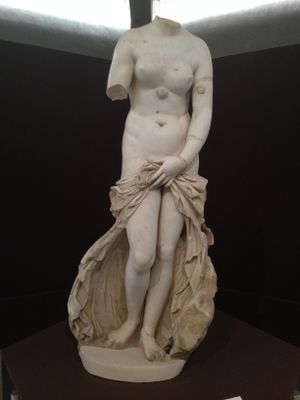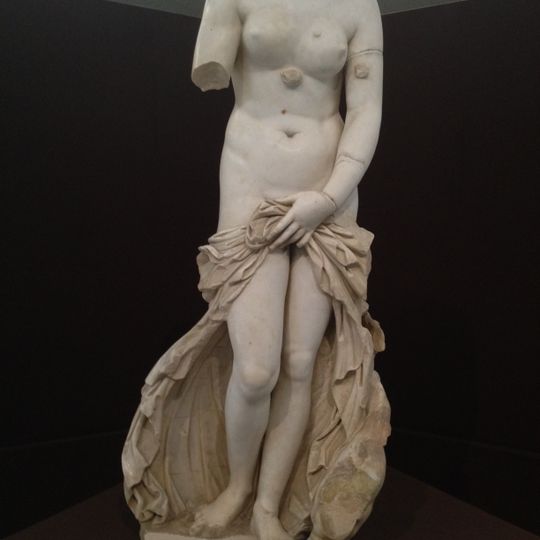
Venus Landolina, Roman marble sculpture in Museo Archeologico Regionale Paolo Orsi, Syracuse, Italy
The Venus Landolina is a Roman marble statue depicting the goddess emerging from water, with her arms positioned to hold attributes that have not survived over time. The work is housed in the Museo Archeologico Regionale Paolo Orsi in Syracuse and belongs to a collection of pieces from the Roman period.
The statue was discovered in 1804 in Syracuse and dates from the 2nd century CE. It is based on an ancient Greek image type depicting Aphrodite emerging from the sea.
Guy de Maupassant saw the statue in 1885 during his tour of Sicily and wrote about it in his travel account "Viaggio in Sicilia", calling it a woman and at the same time a symbol of the flesh. The name Landolina comes from Saverio Landolina Nava, the archaeologist who found it on 7 January 1804.
The statue is located in sector D of the museum, which displays artifacts from the Hellenistic and Roman periods of Syracuse. Visitors can find a collection of sculptures and other objects from this era in this area.
The statue's left arm was assembled from several pieces, and a marble protrusion on the left shoulder remains unexplained. Near the left foot, traces of a lost dolphin are thought to survive. A small red mark sits on the abdomen above the navel.
The community of curious travelers
AroundUs brings together thousands of curated places, local tips, and hidden gems, enriched daily by 92,818 contributors worldwide.