Shintoyone Dam, Arch dam in Toyone, Japan
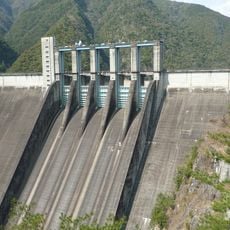
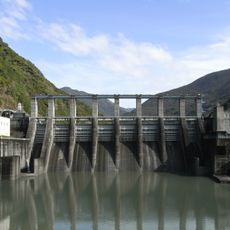
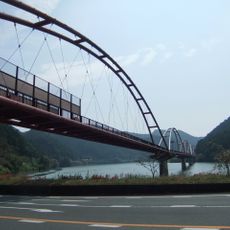
Shintoyone Dam is a 116.5-metre-high concrete arch dam on the Ōnyu River, a tributary of the Tenryū system, in Toyone, Aichi Prefecture. Its crest runs 311 metres, and it impounds Lake Midori, which covers 156 hectares. Two 1,884-metre tunnels link the reservoir to the 1,125-megawatt pumped-storage plant beside Sakuma Dam.
Preliminary surveys on the Ōnyugawa began in 1962, and full construction started in July 1969 after compensation talks with about 100 households to be submerged. The body was finished in 1972 and the whole scheme, built by Kumagai Gumi, entered service in August 1973. Management passed from Aichi Prefecture to the national government that same year.
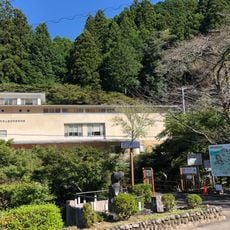
The reservoir behind the dam was named Lake Midori through a public naming competition. The dam's surroundings are laid out as a park with an information board, a monument to workers who died during construction, and public toilets; the dam crest is a walkway open from the left bank to the incline on the right bank.
Access is via National Route 151, then Aichi routes 428 and 429 past the Toyone village office and over Toyone Bridge. A car park for about a dozen vehicles, toilets and an information board stand by the dam. The dam crest is a walkway open from the left bank to the incline on the right bank. The route along the Ōnyu Valley on Aichi route 429 is closed after heavy-rain damage.
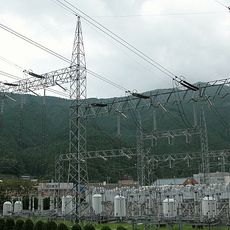
The Shintoyone power station sits about 2 km east of the dam, reached by a headrace tunnel from the reservoir's left bank; its machinery hall is an artificial underground space entered from the Iida-Toyama-Sakuma route. Five vertical Francis pump-turbines include two 50 Hz units, two 60 Hz units and one dual-frequency unit, since the plant lies near the boundary between Japan's two commercial power frequencies.
The community of curious travelers
AroundUs brings together thousands of curated places, local tips, and hidden gems, enriched daily by 93,850 contributors worldwide.