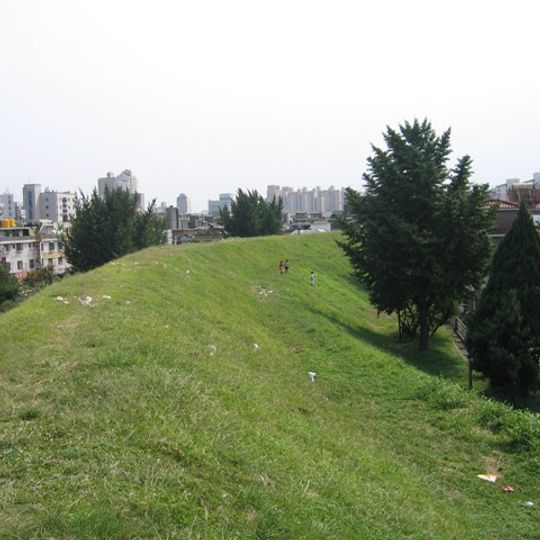
Pungnaptoseong, Earthen fortress ruins in Pungnap-dong, Seoul, South Korea
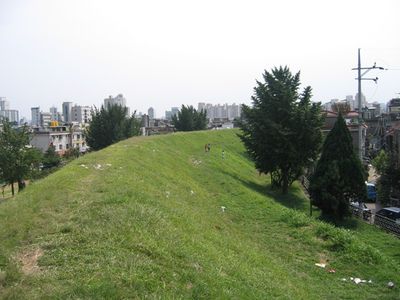
Pungnaptoseong is an ancient fortress whose walls extend for several kilometers along a river and are built from compacted earth mixed with sand and stone materials. The structure demonstrates how people from this period constructed large-scale defensive works.
Pungnaptoseong is identified with Hanam Wiryeseong, the first capital of Baekje, based on research from the Japanese occupation period. It was built on the east bank of the Han River as an earthen fortress. Flooding destroyed part of the walls, leaving 2.7 km of the original 3.5 km circuit. On 21 January 1963 it was designated Historic Site No. 11, originally named Gwangju Pungnap-ri Toseong and later renamed Seoul Pungnap-dong Toseong after administrative changes.
The name Pungnaptoseong combines the Pungnap-dong district with toseong, Korean for earthen wall; the official designation, granted on 21 January 1963 as Historic Site No. 11, was Gwangju Pungnap-ri Toseong, later renamed Seoul Pungnap-dong Toseong after administrative boundary changes. The site is identified with Hanam Wiryeseong, the first capital of Baekje, one of the Three Kingdoms of Korea.
Visitors can walk along the preserved earthen walls and examine the ancient construction methods up close. It helps to wear comfortable shoes since the paths traverse uneven terrain.
The inner wall was heaped at a slant from sandy soil, grit, clay and mud, then capped with three layers of pebbles and trimmed stones set in natural mud. The central part forms a trapezoid 7 m wide at the base and 5 m high. Only 2.7 km of the original 3.5 km circuit survives, the west wall having been lost to flooding.
The community of curious travelers
AroundUs brings together thousands of curated places, local tips, and hidden gems, enriched daily by 93,660 contributors worldwide.