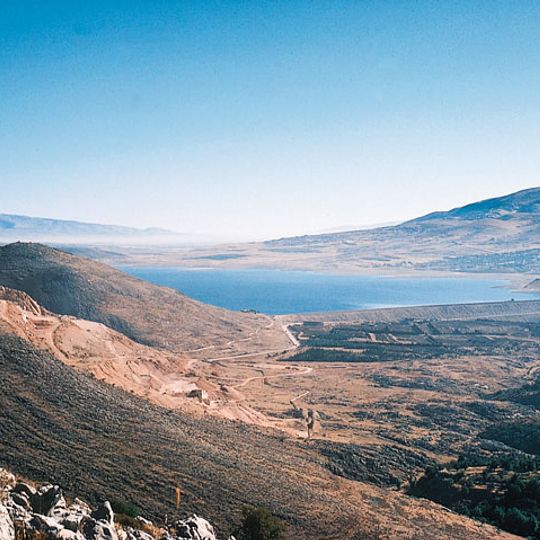
Lake Qaraoun, Artificial lake in Beqaa Valley, Lebanon.
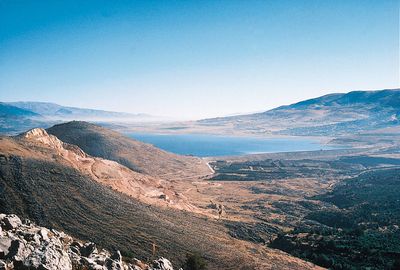
Lake Qaraoun is an artificial reservoir in the Bekaa Valley created by a concrete dam that holds back water from the Litani River. The lake occupies a wide basin surrounded by agricultural land and serves multiple purposes across the region.
Lake Qaraoun was formed in 1959, when the Albert Naccache dam was built across the Litani River between Qaraoun and Sohmor. The 61 m-high concrete-faced rockfill dam, Lebanon's largest, was sited by engineer Ibrahim Abdel Al and geologist Du Bertret. The first of its three downstream power stations, at Markaba, began operating in 1962.
The name Qaraoun comes from the village beside the dam; in Arabic the reservoir is Buḥayrat al-Qara'un. The lake was built at 800 m on the Litani, and its water feeds the Markaba, Awali and Jun power stations. On the eastern shore, farmers work arable fields and olive orchards, while sheep and goats graze the slopes above the water.
The Albert Naccache dam stands at about 800 m elevation between Qaraoun and Sohmor, and the road along the eastern shore passes farmland and olive orchards. Water is drawn down through the dry season for the Markaba, Awali and Jun plants, so the shoreline shifts; the concrete spillway tower in the lake is visible from the dam side.
The reservoir's dam is named after Albert Naccache, and its concrete face is made of slabs 50 cm thick at the base and 30 cm at the top, covering 47,000 m². The spillway is a reinforced concrete tower standing in the water, linked to a tunnel that passes beneath the dam body to the river channel.
The community of curious travelers
AroundUs brings together thousands of curated places, local tips, and hidden gems, enriched daily by 93,474 contributors worldwide.