Sidon Sea Castle, Crusader castle on Mediterranean island, Sidon, Lebanon
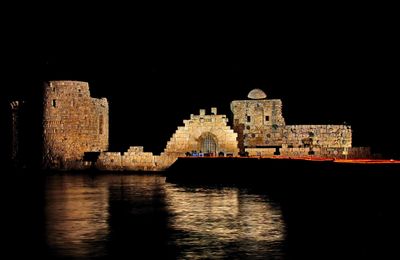
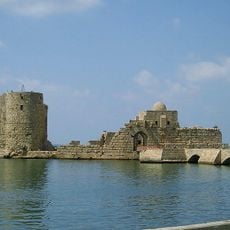
Sidon Sea Castle occupies a low island reached by a causeway about 80 metres long. Its left side is a solid rectangular mass of large pale tan stone blocks, joined by a lower wall to a central pointed archway with a gridded gate and stepped stonework. A taller block with a rounded cap stands to the right, and the far right end is a long low wall pierced by regularly spaced round holes.
The fortress was built in 1228 during the Crusader period, replacing an earlier Phoenician temple dedicated to the god Melqart at that location. This site thus records more than seven centuries of religious and military history.
The castle's entrance is decorated with carved black stones, and inside stands a mosque built by al-Ashraf Salah al-Din Khalil and later renewed by Emir Fakhreddine. The east tower, the castle's main section, measures 27 by 21 metres and was raised in two phases: a Crusader lower part and a Mamluk upper level. Granite columns from older structures were reused in its thick walls.
The castle is reached from the mainland by a narrow causeway about 80 metres long, built on nine stone arches. Inside, a winding staircase climbs to the roof, where a small domed Ottoman-era mosque stands and the old city and fishing harbour come into view. The west tower, left of the entrance, is the better preserved of the two.
The island may have held the palace of the Phoenician king, destroyed by the Assyrian ruler Esarhaddon and later by earthquakes. Assyrian king Sennacherib also recorded fortresses and cisterns at Sidon. The castle later served as a shelter for the city during internal attacks.
The community of curious travelers
AroundUs brings together thousands of curated places, local tips, and hidden gems, enriched daily by 93,471 contributors worldwide.