Berezan' Runestone, Runestone in Odesa Archaeological Museum, Odesa, Ukraine.
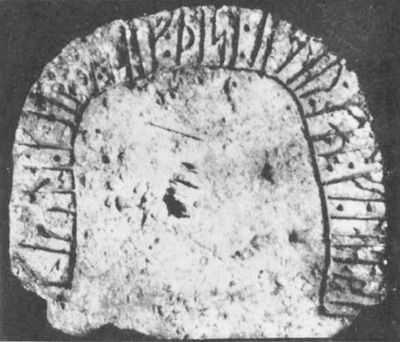
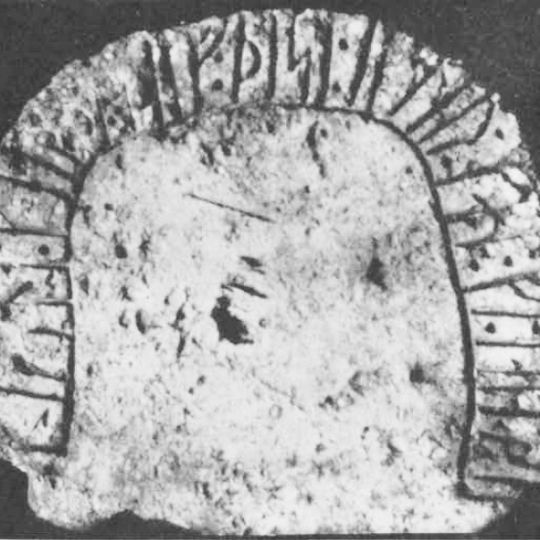
The Berezan Runestone is a limestone slab 47 cm high, 48 cm wide and 12 cm thick, with its lower part missing. A curved band of runes runs along the top and down both sides, separated from the plain centre by an incised line. It is kept in the Odesa Archaeological Museum.
The artifact was discovered in 1905 by Professor Ernst von Stern during excavations on Berezan Island. This find revealed important evidence of Scandinavian presence in the region during medieval times.
The inscription names Grani and his félag (business partner) Karl, showing a mercantile partnership on the Varangian route to Constantinople. The Old Norse word hvalf (vault, coffin) used for the grave points to Gotland, where the same term and similar stone shapes occur. The Russian reading now takes the name as Kal, matching the modern word for cabbage.
The stone is held in the Odesa Archaeological Museum, not at the university. It is a limestone slab 47 cm high and 48 cm wide whose lower part is not preserved, so look for a fragment rather than a complete stele. The runes run in an arc along the upper edge.
The Russian Wikipedia notes that the name read as Karl is now considered a misreading: the inscription actually reads kal, matching the name Kål, 'cabbage', on stones Sö 109 and U 498. The stone was found with its text face down beside a skull in a lidless coffin.
The community of curious travelers
AroundUs brings together thousands of curated places, local tips, and hidden gems, enriched daily by 94,426 contributors worldwide.