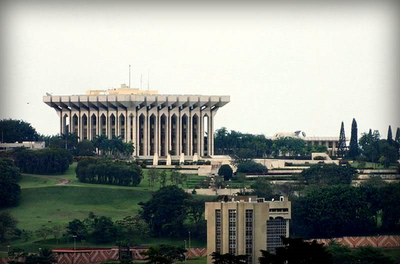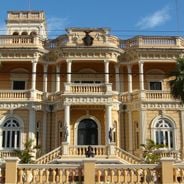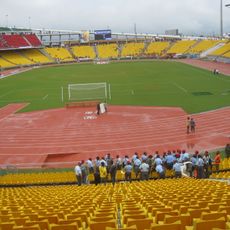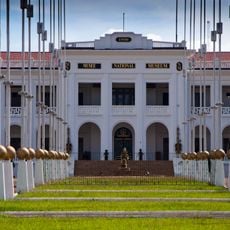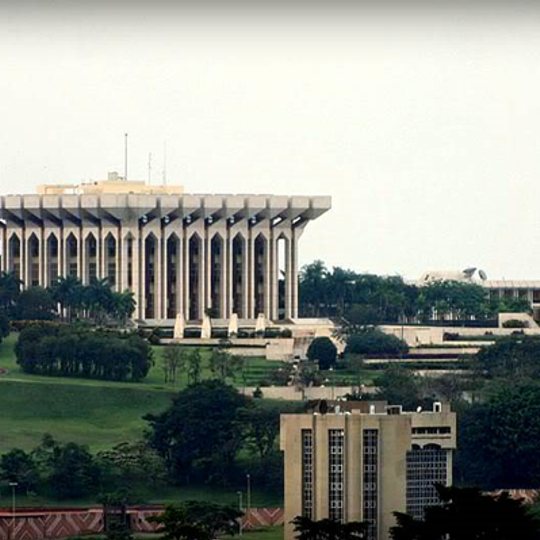
Palais de l'Unité, Presidential palace building in Yaoundé, Cameroon.
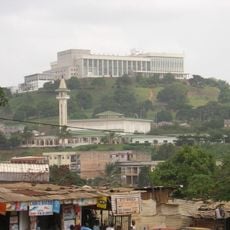
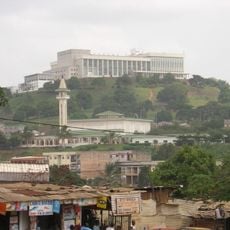
The Palais de l'Unité is a vast complex on a hill in northern Yaoundé, designed by Franco-Tunisian architect Olivier-Clément Cacoub. Its main building, the palace, stands on a raised terrace with a facade of about twenty tall, narrow, pointed-arch bays separated by slender piers and topped by a flat roof line that projects as a horizontal canopy. A low base with steps and a wide landing precedes the arcade, and a smaller blocky annex with yellow-brown walls and rows of windows sits in front.
Built in the early 1980s on a hill that had belonged to the Etoudi, the palace was designed by Franco-Tunisian architect Olivier-Clément Cacoub at a cost of 200 billion CFA francs. President Ahmadou Ahidjo inaugurated it less than four months before resigning in November 1982. Paul Biya, in office since 6 November 1982, has resided there since.
The name Etoudi comes from the indigenous group that originally held the hill where the complex stands. Each 20 May, national day, the president hosts a gala evening at the palace for selected guests; otherwise only screened officials are received there.
The palace is closed to the public; only screened officials and guests at the gala held on the evening of 20 May, Cameroon's national day, enter. The rest of the year the complex can only be seen from outside, from the streets of the northern Yaoundé neighbourhood of Etoudi.
The palace hides an underground world and a bunker where Paul Biya is said to have taken refuge during the bloody coup attempt of 6 April 1984, at the very start of his presidency. No information has ever leaked about the interior layout or capacity of the complex.
The community of curious travelers
AroundUs brings together thousands of curated places, local tips, and hidden gems, enriched daily by 93,053 contributors worldwide.