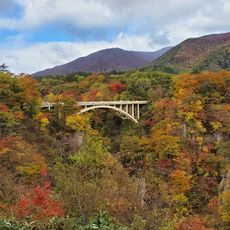
Mount Kurikoma, Active stratovolcano in Tohoku region, Japan.
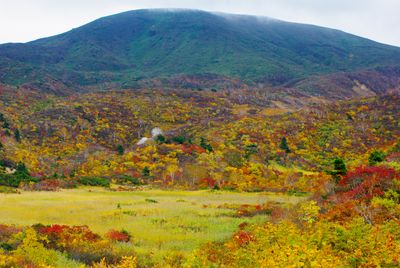
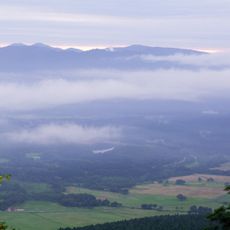
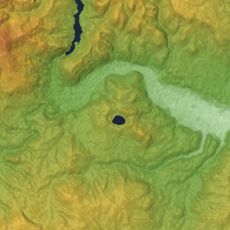
Mount Kurikoma is a 1,626 m andesitic stratovolcano on the borders of Miyagi, Iwate and Akita prefectures. Its summit, marked by a triangulation point named Sukawadake, lies on the Miyagi–Iwate boundary. North of the summit stands the Tsurugi-dake lava dome, and a horseshoe-shaped caldera about 2.2 km across opens to the northwest, with a debris-avalanche slope extending beyond it.
The volcano began erupting about 500,000 years ago, with early lava flows to the north and south followed by the Higashi-Kurikoma and Magusadake cones. The summit caldera formed later, and the Tsurugi-dake lava dome now occupies it. Recorded eruptions include one in 915 and a phreatic blast in 1944 at the site of today's Showa Lake, which discolored the Iwaki River and killed fish.
The name Kurikoma comes from a horse-shaped snow patch, the komagata, that appears on the west side of the summit in early summer. The mountain is listed among Japan's One Hundred Famous Flower Mountains, and in Iwate it is also called Sukawadake, in Akita Dainichidake and in Miyagi Komagatake.
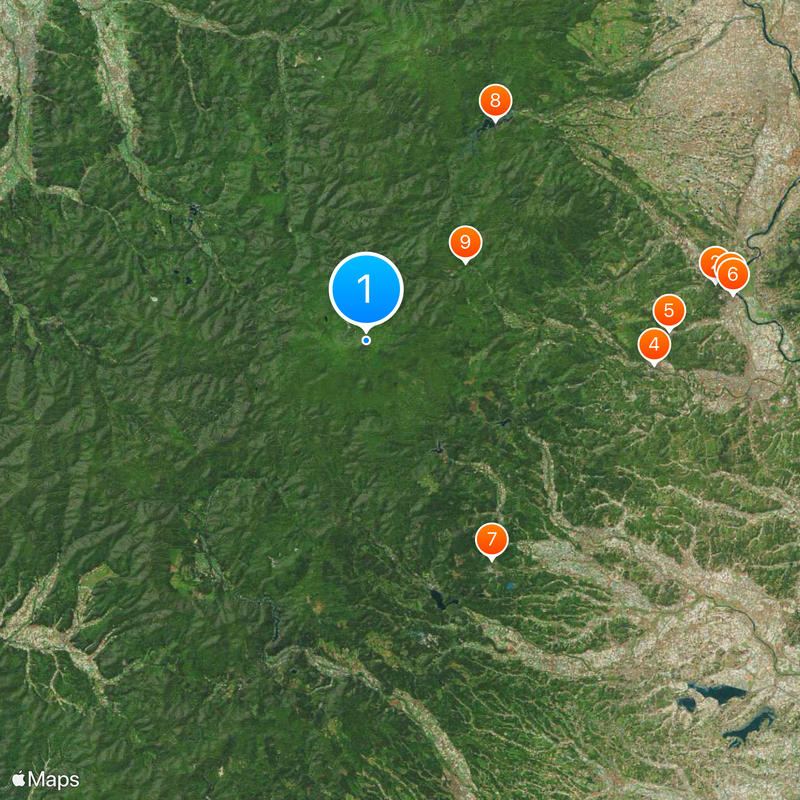
Nine well-marked hiking trails of varying difficulty begin from different starting points around the mountain base and lead to the Kurikoma Rest House. Depending on your chosen route and fitness level, allow different timeframes for the climb.
The summit caldera, about 4 km across, opens to the north, not the northeast, and holds the Tsurugi-dake lava dome. About 500 m north of that dome lies Jigokugama, a crater-like hollow roughly 100 m long, 70 m wide and 50 m deep, called Hachimanyama or Iwoyama in the Edo period.
The community of curious travelers
AroundUs brings together thousands of curated places, local tips, and hidden gems, enriched daily by 93,698 contributors worldwide.