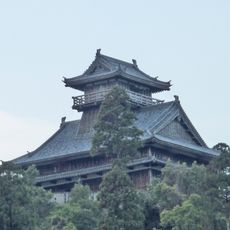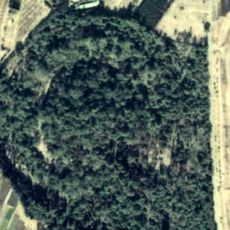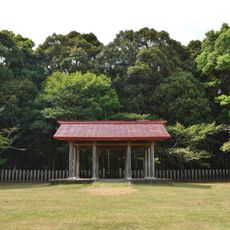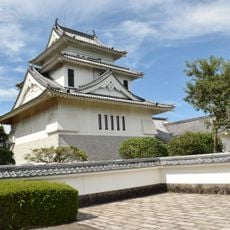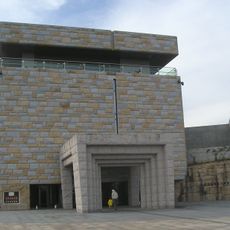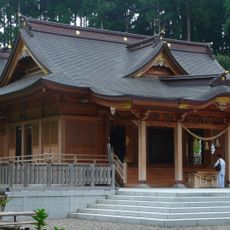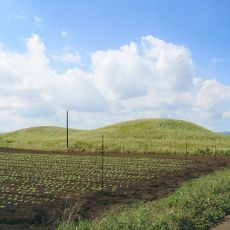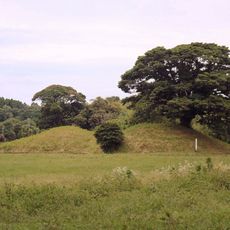
Tonokōri Castle, Japanese castle ruins in Saito, Japan.
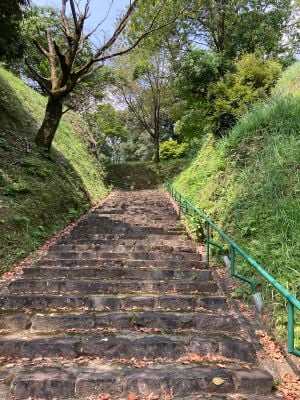
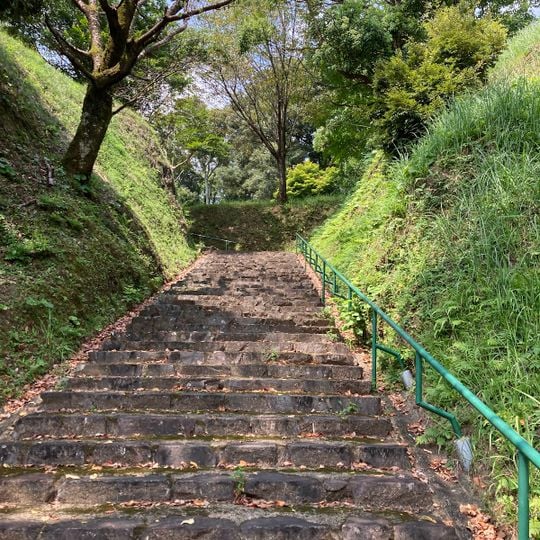
Tonokōri Castle is a ruined yamajiro on a roughly 100-meter-high hill on the right bank of the Sanzai River, which served as its outer moat to the west and north. Five enclosures—Honmaru, Ninomaru, Sannomaru, Okunoshiro and Nishinoshiro—are separated by deep dry moats and earthen ramparts, with over ten terraced enclosures below them. The moats ran more than four kilometers in total.
Itō Sukemochi built the castle in 1335 or 1337 after receiving estates from Ashikaga Takauji. Under his son Sukeshige it became the Itō clan's main stronghold, centre of a network of 48 forts. A fire on 5 March 1504 destroyed much of the castle and its town. After the 1577 Battle of Kizaki the Shimazu occupied it, and the 1615 one-castle law ended it.
The castle's alternative name, Ukibune Castle ("Floating Boat Castle"), comes from the Sanzai River serving as its outer moat, its walls reflected in the water. Itō Yoshisuke, the tenth head of the clan, praised the site in a poem: "In spring flowers, in autumn crimson leaves, I raise my sail through mist and haze at Ukibune Castle." The castle grounds also contain a mausoleum tradition for Hohodemi no Mikoto, and a statue of Itō Mansho, born here, stands on the site.
The ruins lie about 35 minutes by car from Sadowara Station on the JR Kyushu Nippō Main Line. The site is overgrown, with uneven ground and earthen ramparts, so sturdy footwear helps. Allow time to walk between the five enclosures and the outlying forts.
The castle was part of a larger network of interconnected defensive sites spread across the region with smaller outposts on surrounding hilltops. This distributed system reveals how multiple fortifications worked together as a coordinated defense strategy.
The community of curious travelers
AroundUs brings together thousands of curated places, local tips, and hidden gems, enriched daily by 94,153 contributors worldwide.