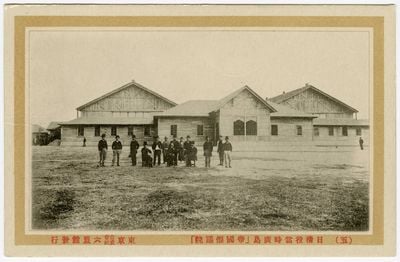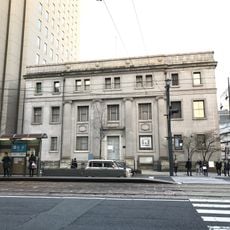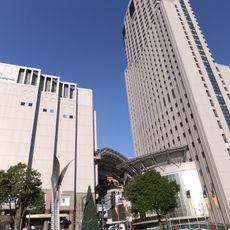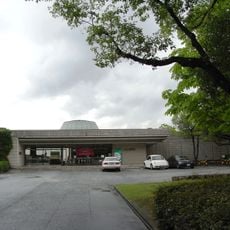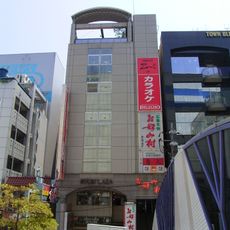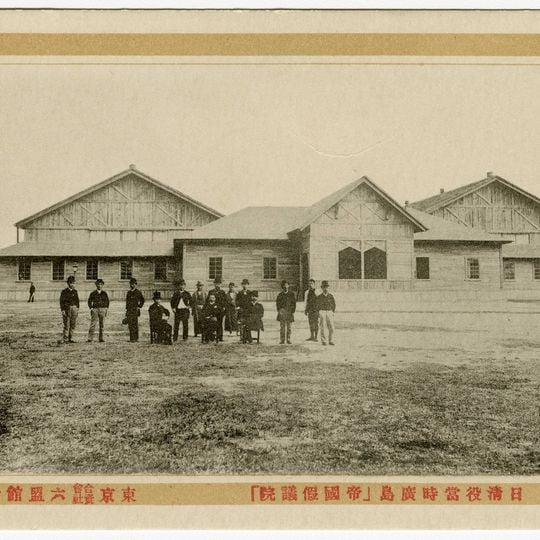
National Diet Hiroshima Temporary Building, Parliament building in Hiroshima, Japan.
The National Diet Hiroshima Temporary Building was a wooden parliament structure in Hiroshima designed to house legislative sessions. The design merged traditional Japanese architectural methods with the practical needs of a modern governmental assembly space.
Built in 1894 for the 7th Imperial Diet, which met in Hiroshima after the city became the de facto capital during the First Sino-Japanese War. Tsumaki Yorinaka's design was erected in about 20 days, from 30 September to 14 October. The Diet sat for four days, from 18 to 22 October. The building was later used by the army as a reserve hospital, divisional headquarters and school, and demolished from 2 December 1898.
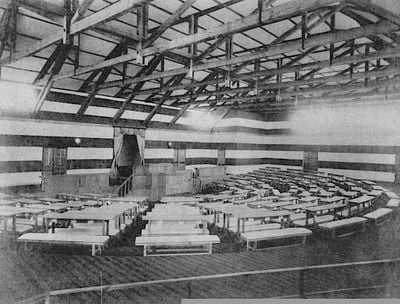
The interior walls were covered with dark blue and white cloth in horizontal stripes, modelled on the curtains of a field camp (jinya maku). The building was erected by nearly 1,000 local Hiroshima carpenters, and almost all materials were sourced in Hiroshima at Tsumaki Yorinaka's wish. Staff and stenographers working inside were bothered by flies from the army horses kept nearby.
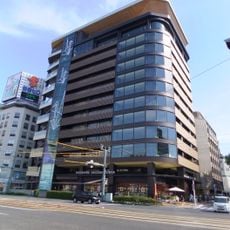
The building no longer exists: it was dismantled starting 2 December 1898, and the site in present-day Naka Ward, Motomachi 9-33, is now occupied by the Chugoku Electric Power Motomachi Building. A stone monument, the Hiroshima Temporary Imperial Diet Site marker, stands near that building's main entrance. The only relocated part, the imperial antechamber, was moved to Hijiyama but was destroyed by the 1945 atomic bomb.
To save time, Tsumaki Yorinaka skipped foundations and used post-in-ground construction, and had uninstalled telegraph poles bought up as timber. Nearly 1,000 local carpenters worked on the hall, and staff inside were bothered by flies from the army horses kept nearby.
The community of curious travelers
AroundUs brings together thousands of curated places, local tips, and hidden gems, enriched daily by 94,340 contributors worldwide.