Kawah Ijen acid lake

Log in to your account

AroundUs is a community-driven map of interesting places, built by curious explorers like you. It grows with every review, story, and photo you share.
Connect to save your favorite spots, contribute locations, and create personalized routes.
By continuing, you accept our Terms and Conditions and our Privacy Policy

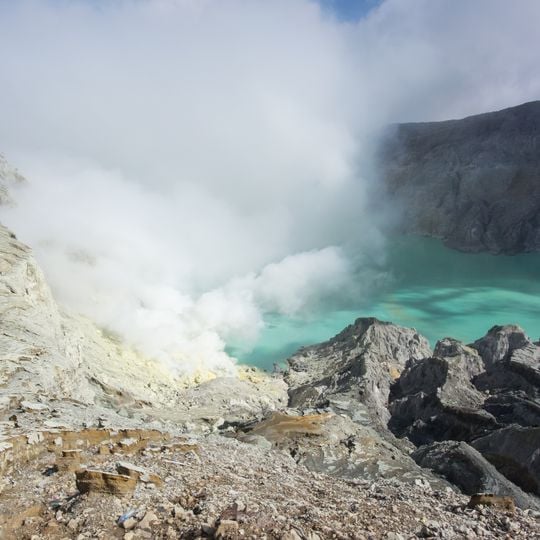
Kawah Ijen acid lake

Add to collection
Map
Suggest a change
Share

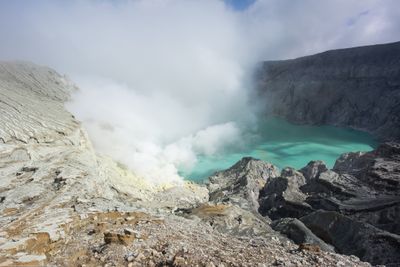
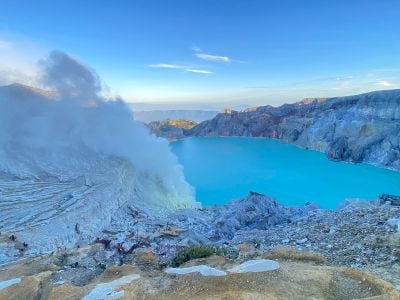
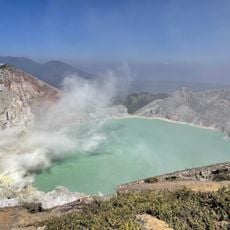
Kawah Ijen acid lake, Volcanic crater lake in East Java, Indonesia

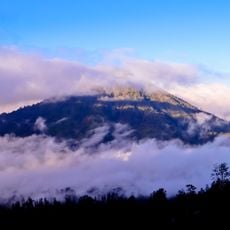
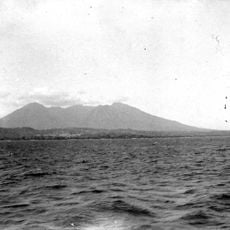
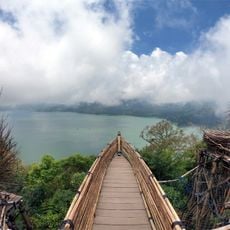
Kawah Ijen is a crater lake within the Ijen volcano complex in East Java, distinguished by its striking turquoise water and considerable depth. The lake sits within a volcanic crater at high elevation, surrounded by steep walls that allow for sulfur extraction activities.

The crater lake formed through volcanic activity, with its last major magmatic eruption occurring in 1817. Since then, smaller volcanic events continued to affect the region into the 21st century.

Sulfur mining has been a livelihood for local communities for generations, with workers descending into the crater to extract and carry the mineral. This labor defines the daily rhythm of the villages surrounding the volcano.

A visit requires a nighttime hike to the crater to witness the striking blue flames from burning sulfur gases. The climb is demanding and requires good physical fitness along with appropriate gear for dark and potentially harsh conditions.

The lake's water is extremely acidic with a pH level near zero, representing one of the highest acid concentrations found anywhere. This extreme acidity means almost no life exists in the water itself, creating an otherworldly and unforgettable environment.

Elevation above the sea: 2,200 m

Part of: Ijen

Address: Kawah Ijen, East Java, Indonesia

GPS coordinates: -8.05750,114.24150

Latest update: December 6, 2025 17:45

Photos
Satellite images showing incredible locations seen from the sky

Satellite imagery has transformed how we view remote locations on Earth, offering perspectives on places that are often invisible or difficult to reach from ground level. This collection presents natural formations, artificial structures and historical sites from an aerial vantage point. From geological features like the circular Richat Structure in Mauritania's desert to ancient geoglyphs and modern engineering achievements, these images provide a distinct view of our planet's diversity. Locations documented include the geometric Nazca Lines in Peru, the pyramid structure of El Castillo in Mexico's Yucatán Peninsula and the Badlands Guardian in Alberta, a natural rock formation that resembles a head wearing headphones when seen from above. The collection also features Palm Jumeirah in Dubai, an artificial archipelago shaped like a palm tree, the vivid blue potash evaporation ponds in Utah, the pink waters of Lake Hillier in Western Australia and the volcanic island of Surtsey off Iceland. Additional examples include the Atacama Giant in Chile, a prehistoric geoglyph, the heart shaped Galesnjak island off Croatia's coast and the ship graveyard of the former Aral Sea in Uzbekistan, which documents the ecological consequences of human intervention.

Unusual landmarks and natural sites across the globe

Earth presents numerous geological formations, natural phenomena, and architectural structures that stand out through their exceptional characteristics. This collection documents such sites across all continents: the Darvaza Gas Crater in Turkmenistan, burning for decades; the luminescent glowworms in New Zealand's Waitomo Caves; the terraced limestone pools of Pamukkale in Turkey; and the layered sediment patterns of The Wave in Arizona. Additional locations include the basalt columns at Bushmills in Northern Ireland, the deep blue expanse of Aokigahara Forest at the base of Mount Fuji, the Chocolate Hills in the Philippines with their conical mounds, and the acidic turquoise waters of Kawah Ijen crater lake in Indonesia. The collection also features human-made curiosities such as Quinta da Regaleira in Sintra with its spiral initiation well, the Winchester Mystery House in California with its unusual architecture, and Las Pozas in Mexico, a surrealist garden of concrete constructions in the jungle. Natural phenomena are equally represented: the Racetrack Playa in California with its moving rocks, the optical illusion of Magnetic Hill in New Brunswick, the Caño Cristales in Colombia whose riverbed appears in bright colors, and Lake Natron in Tanzania with its high alkaline content. Each location demonstrates specific geological processes, climatic conditions, or cultural developments that distinguish these places from typical travel destinations.

Reviews

Visited this place? Tap the stars to rate it and share your experience / photos with the community! Try now! You can cancel it anytime.

« Kawah Ijen acid lake - Volcanic crater lake in East Java, Indonesia » is provided by Around Us (aroundus.com). Images and texts are derived from Wikimedia project under a Creative Commons license. You are allowed to copy, distribute, and modify copies of this page, under the conditions set by the license, as long as this note is clearly visible.

Discover hidden gems everywhere you go!

From secret cafés to breathtaking viewpoints, skip the crowded tourist spots and find places that match your style. Our app makes it easy with voice search, smart filtering, route optimization, and insider tips from travelers worldwide. Download now for the complete mobile experience.
Around Us App Screenshot

A unique approach to discovering new places

Le Figaro

All the places worth exploring

France Info

A tailor-made excursion in just a few clicks

20 Minutes