Ahmad ibn Hanbal Mosque, Religious complex in Baghdad, Iraq
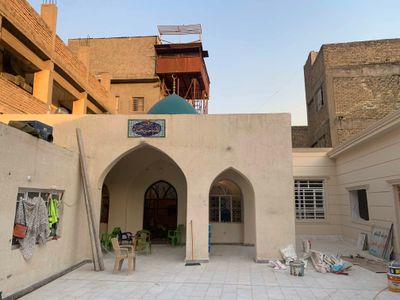
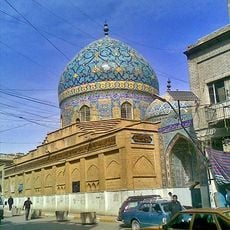
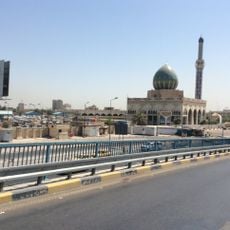
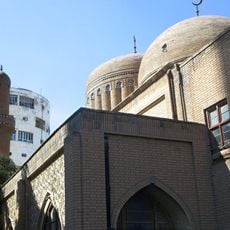
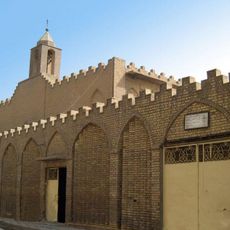
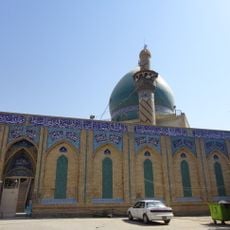
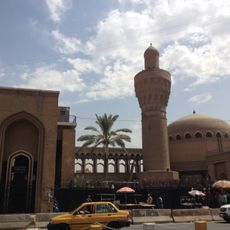
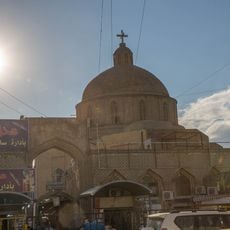
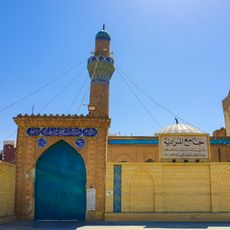
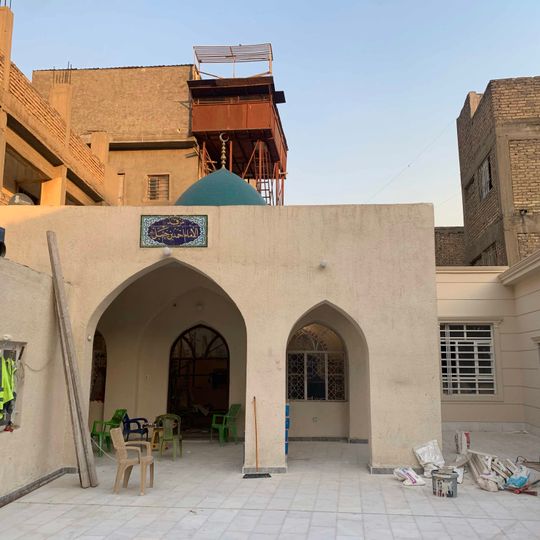
The Ahmad ibn Hanbal Mosque, also known as the Arif Agha Mosque, is a small Sunni mosque in Baghdad's Rusafa area. Its pale beige plastered facade has a large central pointed archway and a smaller pointed archway to its right. Above the central arch is a rectangular blue tile panel with white Arabic calligraphy; behind rises a green dome topped by a rust-brown wooden enclosure on metal supports. Inside are a prayer hall, a small courtyard, and a domed mausoleum room.
The mosque, completed in the Iraqi-Ottoman style most likely before 1937, was originally known as the Arif Agha Mosque, a name possibly taken from an Iraqi noble family whose majlis was held nearby. In 1937, during a Tigris flood, the remains attributed to Ahmad ibn Hanbal (780–855) were reportedly moved here from the Bab al-Harb cemetery, though later historians doubt the account. The mausoleum room was reconstructed in 1998, and in late December 2025 the Sunni Endowment Office approved funding to restore it.
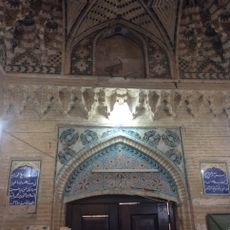
The name Arif Agha Mosque comes from the Iraqi family of that name, whose majlis met near the Nazanda Khatun Mosque; Mahmud Effendi Arif Agha led it after his father's death in 1864. The marble tombstone over the grave is covered with layers of cloth and silk donated by pilgrims over time. Local Hanbalis reject domed mausoleums, and locals long refused to restore the dome.
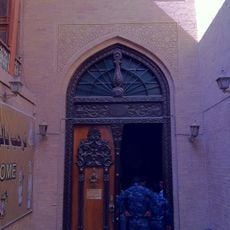
The mosque sits in the Haydar-Khana locality of Rusafa, behind the former Islamic Bank building on al-Maidan Street, near the Nu'aima al-Jibaji Mosque. The main entrance is very narrow, and the mausoleum room holds no more than 30 people, so groups should coordinate ahead. The last renovation was in 2010, and in late December 2025 the Sunni Endowment Office approved funding to restore the mausoleum.
The tombstone over the grave is draped in layers of cloth and silk donated over the years by visiting pilgrims. The mausoleum room holds no more than 30 people, and the mosque's main entrance is very narrow. Local tradition holds that the remains were brought here after the Tigris flooded Bab al-Harb in 1937, a story modern historians doubt.
The community of curious travelers
AroundUs brings together thousands of curated places, local tips, and hidden gems, enriched daily by 92,655 contributors worldwide.