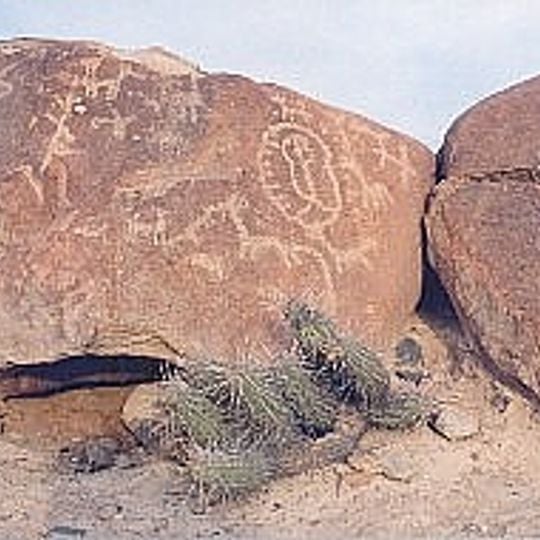
Miculla petroglyphs, Ancient petroglyph site in Tacna department, Peru
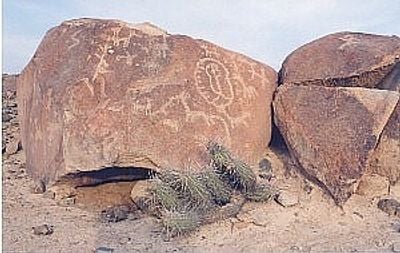
The Miculla petroglyphs, also called San Francisco de Cuculla, are a group of carvings on both banks of the Palca River near its confluence with the Caplina, close to the village of Miculla in Pachía, Tacna Department, Peru. Most are at kilometre 22 of the Tacna–Bolivia highway and cover 16 km². The images are pecked or hammered into limestone or silica rock in low relief, showing humans in profile hunting, dancing with feather headdresses, holding staffs or rowing rafts, along with deer, guanacos, vicuñas, felines, foxes, birds, snakes, lizards, cacti, flowers and maize.
The petroglyphs were carved at different periods, some from pre-agricultural times and others from agricultural eras, with proposed dates ranging from 500 AD to 1445 AD. They lie on both sides of the Palca River near its confluence with the Caplina, and most are found around kilometre 22 of the Tacna–Bolivia highway, across an area of 16 km².
The carvings show hunting scenes, dances, and animals that visitors can observe directly on the rocks as they walk through the site. Certain motifs repeat across many stones, suggesting that some subjects held a special place in the daily life of the people who lived here.
The carvings lie at kilometre 22 of the Tacna–Bolivia road, about 22 km from Tacna, on both banks of the Palca river near its confluence with the Caplina. The main concentration covers 16 km² of open pampa, so expect walking between rock faces in desert heat. The ground is sandy and uneven, with an overhanging rock face at some panels.
The site covers 16 km² along both banks of the Palca River near its confluence with the Caplina, at kilometre 22 of the Tacna–Bolivia road. The carvings were made by scraping or hammering the limestone and silica rock surfaces, not by cutting deep grooves.
The community of curious travelers
AroundUs brings together thousands of curated places, local tips, and hidden gems, enriched daily by 94,420 contributors worldwide.