Balcón de Huaura, Colonial balcony and war museum in Huaura, Peru
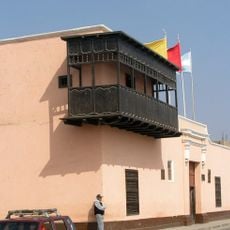
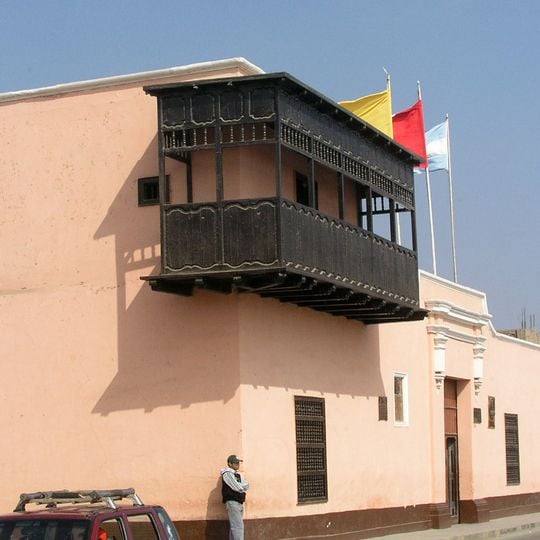
The Balcón de Huaura is a 17th-century house on Huaura's Plaza de Armas, built with quincha, mud and Nicaraguan wood. Its dark wooden enclosed balcony projects from the upper wall on curved brackets, with a scalloped balustrade and slender turned posts supporting a flat roof. The house has a façade, a zaguán and a main courtyard.
From this balcony, General José de San Martín proclaimed Peru's independence on November 27, 1820, making it the stage for a decisive moment in the nation's liberation. The location became a symbol of the end of Spanish colonial rule in the region.
Locals call it the Balcón de la Independencia, and the name is tied to the 1921 centenary of independence, when a large demonstration was staged here with the balcony as its main setting. Since 1974 the house has served as a museum space, officially named the Museo Monumental de la Municipalidad Distrital de Huaura in 1996. During city celebrations a replica of Peru's first flag, designed by San Martín, replaces the original, which has stayed in Lima since its 1985 theft.
The museum occupies a 17th-century house on Huaura's Plaza de Armas, with a façade, entrance hall and main courtyard. The building belongs to the District Municipality of Huaura, while the balcony itself is owned by the Peruvian State. Visits focus on the courtyard and exhibition rooms; the balcony is viewed from the square.
The building operates under a split administrative structure, with the museum sections run by the city government while the balcony itself remains under national control. This unusual arrangement reflects how the balcony holds symbolic weight as a national monument separate from the museum operations.
The community of curious travelers
AroundUs brings together thousands of curated places, local tips, and hidden gems, enriched daily by 93,538 contributors worldwide.