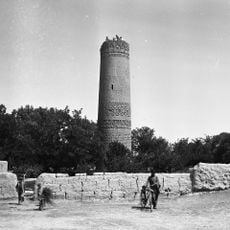
Tillya Tepe, Archaeological site in Sheberghan, Afghanistan
Tillya Tepe is an archaeological site in Jowzjan Province in northern Afghanistan, where six burial mounds hold the graves of six individuals. The site contains over 20,000 items made from gold, silver, ivory, and other materials discovered within the tombs.
Viktor Sarianidi led a Soviet-Afghan team that excavated six intact tombs at Tillya Tepe in 1978, five of women and one of a man. Coins placed in the graves, including a gold coin of the Roman emperor Tiberius minted at Lugdunum between 16 and 21 CE, date the burials to the first century CE. The dead are linked to the Yuezhi, the future Kushans, or to Saka or Parthian groups.
The finds mix Hellenistic forms, such as rings inscribed with Athena's name in Greek, with Chinese bronze mirrors and Indian ivory plates. This reflects the Seleucid and Greco-Bactrian presence in Bactria until about 140 BCE, not Silk Road trade. The gold crown and polylobed daggers resemble Scythian work from the Bosporus region.
The site itself lies in a hard-to-reach area and is not normally open to visitors. Many of the recovered pieces are occasionally displayed in museums worldwide and offer a view of the finds there.
The entire collection disappeared during the wars and resurfaced only in 2003 in sealed vaults beneath the central bank in Kabul. Museum staff had secretly locked it there to protect it from looting.
The community of curious travelers
AroundUs brings together thousands of curated places, local tips, and hidden gems, enriched daily by 92,572 contributors worldwide.