Saint Peter of the Bar Fortress, Portuguese military fortress in Luanda, Angola.
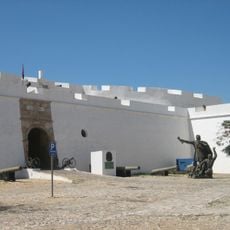
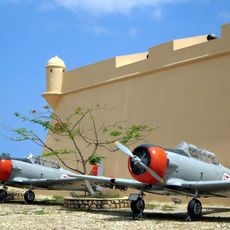
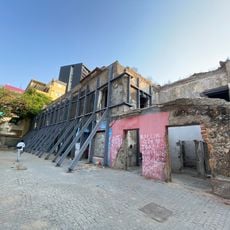
The Fort São Pedro da Barra de Luanda stands on the former Morro de Cassandama, now the Angola Quiluanje neighbourhood, directly on the rocky shore. Its long, low wall of grey-brown rectangular blocks is pierced by one row of small square openings, with a flat-topped stone structure rising at its centre. The plan is an irregular polygon close to a square, with half a bastion on each edge and walls of varying thickness.
The site began as an artillery battery cut into the seaside rocks by the Dutch West India Company during its control of Luanda from 1641 to 1648. After Salvador Correia de Sá e Benevides retook the city, King Afonso VI ordered the harbour defences strengthened in 1663, and the Luanda city council chose Cassandama for a new fort, begun in 1703 and paid for entirely by the city. It later served as a slave entrepot and then a prison from the 19th century into the early 20th, and was restored in 1942-1943 by captain Durão Paias.
The fort's name comes from Saint Peter and its position on the bar, the harbour entrance. It served as a slave entrepot for captives in transit to the Americas, and its ruins were classified a National Monument by Provincial Decree no. 1057 of 9 September 1932. It belongs to the state, under the Ministry of Defence and the Ministry of Culture.
The site is reachable on foot and offers viewpoints of the city and harbor from above. Visitors should wear sturdy shoes since the ground is uneven and shade is limited.
The fort was begun not by the Portuguese but by the Dutch West India Company, who cut an artillery battery into the sea-side rocks while holding Luanda from 1641 to 1648. After Salvador Correia de Sá e Benevides retook the city, the town hall chose Cassandama for a new fort in 1703, paid entirely by the city.
The community of curious travelers
AroundUs brings together thousands of curated places, local tips, and hidden gems, enriched daily by 94,456 contributors worldwide.