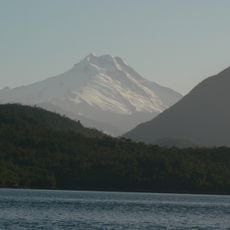
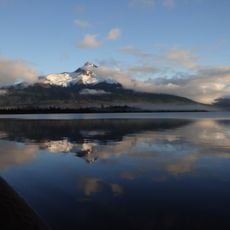
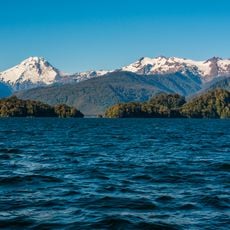
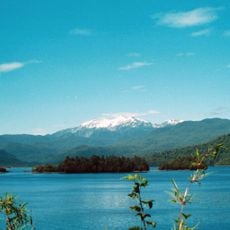
Mount Hudson, Stratovolcano in Aysén Region, Chile.
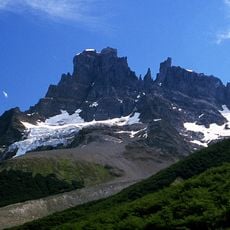
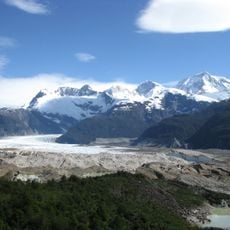
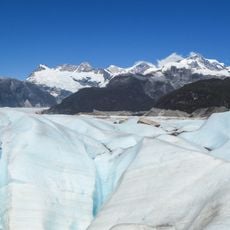
Mount Hudson is a 10-kilometre-wide ice-filled caldera in the Aysén Region, reaching 1,905 metres at its highest point. Only the western and southern rims are well defined, and steep valleys cut up to 1 kilometre into its outer slopes. The Huemules Glacier, 11 kilometres long, flows out of the northwestern side.
Hudson erupted four times on a large scale: around 17,300 BP, 7,750 BP, 4,200 BP and in 1991, the last of these counted among Chile's most violent eruptions. The 7,750 BP event disrupted ecosystems and human settlement in Patagonia and Tierra del Fuego. Ash from 1991 fell across Chile and Argentina, killed large numbers of farm animals and reached Antarctica. A smaller eruption occurred in 1971, and activity resumed on 27 October 2011.
The 7,750 BP eruption devastated the local ecosystem and may have forced substantial shifts in human settlement and lifestyle in Patagonia, with effects reaching Tierra del Fuego. The 1991 eruption buried farmland in ash as far as Argentina and Antarctica. Small populations, mostly farmers, still live in the surrounding valleys.
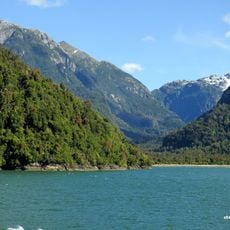
Access is by sea up the Huemules River valley or overland through the Blanco River valley from Lago Elizalde-Lago Caro. The Carretera Austral runs 30 km from the volcano, and the nearest towns are Puerto Aysén, 58 km north-northwest, and Coyhaique, 75 km northeast. Farmers live in the surrounding valleys.
Dense forest long concealed this volcano from recognition, explaining why its existence was documented only recently. This hidden nature makes it one of the lesser-known yet active volcanoes of South America.
The community of curious travelers
AroundUs brings together thousands of curated places, local tips, and hidden gems, enriched daily by 94,356 contributors worldwide.