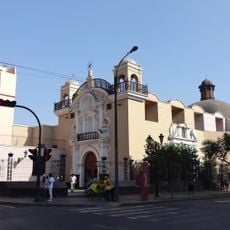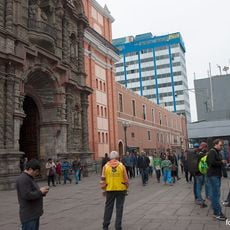
Sanctuary of Las Nazarenas, Carmelite church and monastery in Lima District, Peru
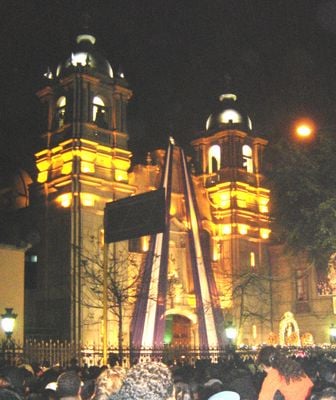
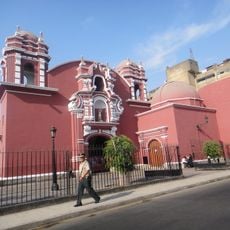
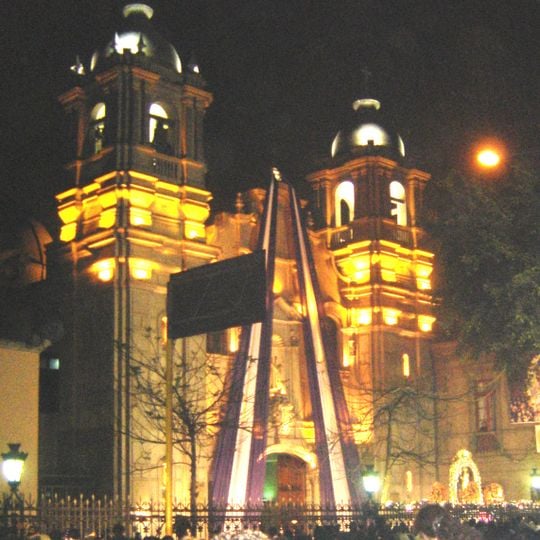
The Sanctuary of Las Nazarenas is a church and Discalced Carmelite convent in the historic centre of Lima, built in the Rococo style and inaugurated on 20 January 1771. Its facade has two symmetrical bell towers topped by domes and crosses, with arched openings; between them rises a tall, narrow structure draped in broad purple and white fabric bands forming a peak, with a dark rectangular panel hanging before it. Below is an arched entrance with a lit interior, and a metal fence with vertical bars runs across the foreground.
The first church on the site was built after Sebastián de Antuñano y Rivas bought the surrounding land on 5 July 1684. It was practically demolished in 1746, and a new temple, promoted by Viceroy Manuel Amat y Juniet, was inaugurated on 20 January 1771. Later earthquakes led to repeated renovations of the building.
The purple habit worn by devotees of the Lord of Miracles comes from the beatas of the Nazarene beaterio, who received the church and adjoining land from Sebastián de Antuñano on 12 October 1700. The Discalced Carmelite nuns still wear purple rather than the traditional Carmelite brown, and they are the image's only guardians. The procession leaves this church on 18, 19 and 28 October.
The complex is open for visitors during daytime hours, with entrances located on Tacna Avenue. The areas are easily walkable, and visitors should know that respectful behavior is expected, especially during religious services.
The image of the Lord of Miracles was painted on an adobe wall by an Angolan slave in 17th-century Lima. The 1655 earthquake destroyed the surrounding slave dwellings but left that wall standing, and the painting is still venerated on the main altar. The purple habit of the Nazarene nuns, kept instead of the Carmelite brown, comes from the beatas who wore it.
The community of curious travelers
AroundUs brings together thousands of curated places, local tips, and hidden gems, enriched daily by 92,748 contributors worldwide.