Templo Budista de Brasília, Buddhist temple in Plano Piloto, Brazil.
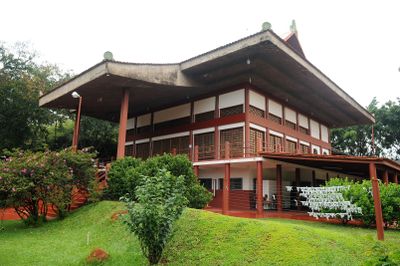
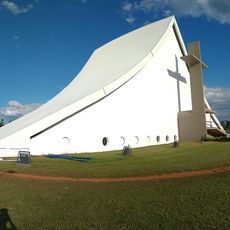
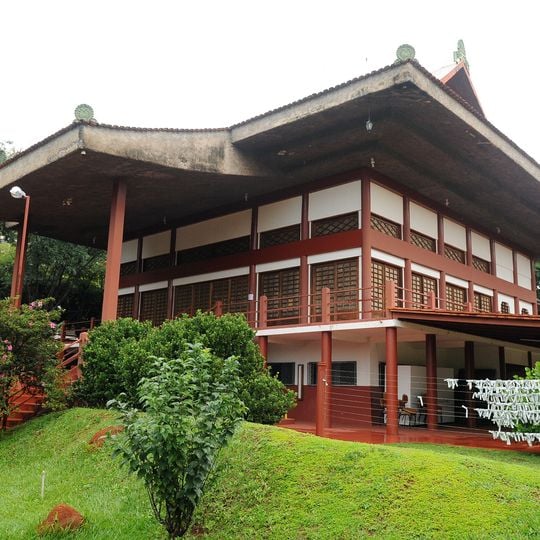
The Templo Budista de Brasília, also called Honpa Hongwanji, stands between blocks 315 and 316 of the Asa Sul on a 7,200 m² plot. Its design, drawn in Japan and adapted by architect Jihei Noda, follows the Reisenji temple in Fukui: two circular earthen-painted portals marked Serenidade and Pureza, a bell house inaugurated in 1990, and a two-storey main building whose straight-edged Shinto-style roof can be seen from lower commercial blocks. A 20-step stairway leads up to the hall, where a standing Buddha Amida sits on the central altar between two side altars to the Shin school's founders.
The Buddhist community received land approval from President Juscelino Kubitschek in 1958, two years before Brasilia's official inauguration. This made it one of the earliest institutions established in the newly planned city.
The temple serves as a center for its Asian community, where people gather for meditation sessions and celebrate traditional festivals together. Visitors can experience how Japanese heritage has found a home within the Brazilian city.
The temple stands at the end of Asa Sul, between blocks 315 and 316, on a 7,200 m² plot. From the entrance portico, a 20-step staircase leads up to the main hall on the upper floor; the ground floor holds the social hall and meeting rooms. The bell house, added in 1990, sits apart from the main building.
The bell donated by Japanese Buddhists hangs in a small tower inaugurated in 1990, designed by Brasília-based architect Jun Ito. The main Buddha image and the altar were also gifts from Japanese Buddhists. The temple's design follows the Reisenji temple in Fukui Prefecture, Japan.
The community of curious travelers
AroundUs brings together thousands of curated places, local tips, and hidden gems, enriched daily by 92,816 contributors worldwide.