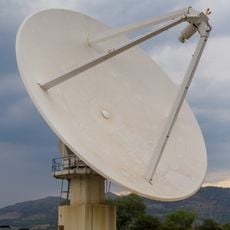
Hartebeesthoek Radio Astronomy Observatory, Radio astronomy observatory in Krugersdorp, South Africa.
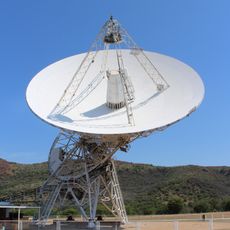
The Hartebeesthoek Radio Astronomy Observatory is a radio astronomy facility in a natural bowl of hills at Hartebeesthoek, about 50 km west of Johannesburg. Its main instrument is a 26-metre parabolic dish of 260 tons on a parallactic mount, built in 1961 as an 85-foot antenna. The dish was originally lined with aluminium mesh, replaced in 1968 by perforated aluminium sheets, and the feed was changed to the Cassegrain principle in 1964.
Built by NASA and ready in July 1961 as Deep Space Instrumentation Facility 51, the 26-metre dish was fitted with an aluminium mesh and a 960 MHz receiver for tracking deep-space probes. It received the first Mars surface images from Mariner 4. NASA ended operations in 1974 after the Madrid 64-metre station opened, handing the antenna to South Africa's CSIR, which converted it to radio astronomy.
The observatory works with universities across South Africa, giving students hands-on training in radio astronomy and engineering research. This partnership allows young scientists to gain practical experience with real astronomical data.
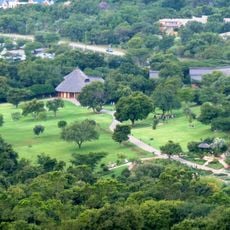
The facility sits in a natural bowl of hills beside the Magaliesberg mountains, where the landscape shields it from urban radio interference. Despite this remote setting, the observatory remains relatively accessible from Johannesburg.
The facility participates in global observation projects where multiple radio telescopes across different continents coordinate to gather data together. This worldwide collaboration enables more precise and detailed measurements of astronomical phenomena.
The community of curious travelers
AroundUs brings together thousands of curated places, local tips, and hidden gems, enriched daily by 94,467 contributors worldwide.