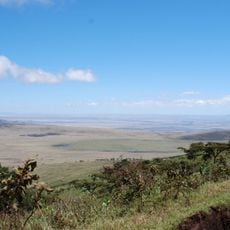
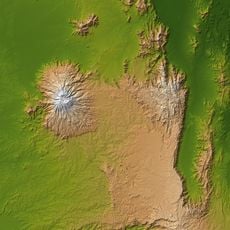
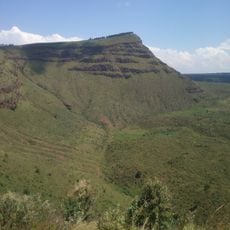
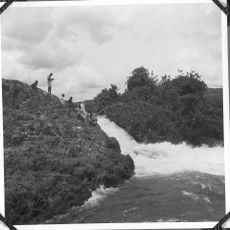
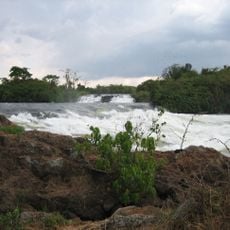
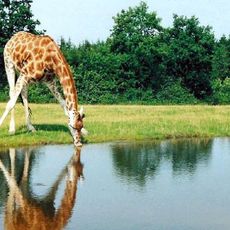
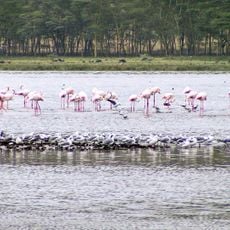
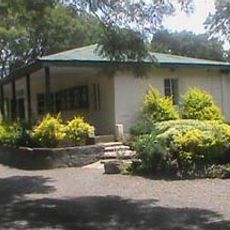
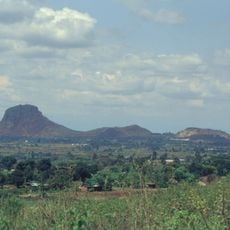
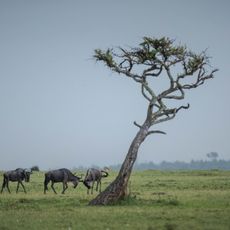
Mount Homa, Carbonatite volcano in Homa Bay County, Kenya.
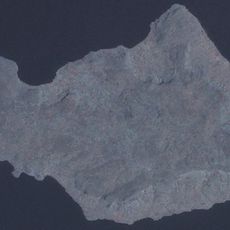
Mount Homa is a complex volcano in Homa Bay County, western Kenya, made of carbonatite lava and rising 1,751 metres above sea level, about 600 metres above Lake Victoria. It forms a broad peninsula on the southern shore of the Winam Gulf, roughly 20 kilometres north of Homa Bay town. Its complex includes 11 cones and one maar.
Mount Homa formed through volcanic activity that shaped the landscape and shoreline of Lake Victoria. Nearby archaeological sites like Kanjera show that people have lived in this region for at least 2 million years, leaving behind early tools and evidence of early human presence.
In Dholuo, the mountain is called Got Uma or God Marahuma, meaning "famous mountain". The name is the main cultural marker recorded for the peak, and it is the term local residents use for the landform that closes the southern side of Winam Gulf.
The summit stands at 1,751 m, roughly 600 m above Lake Victoria, whose shore lies about 3.9 km away. The complex has 11 cones and one maar, so routes differ in length and gradient. The geothermal field heats water to 80 °C, so treat hot ground and springs with care.
Mount Homa is one of the very few carbonatite volcanoes in the world, alongside the active Ol Doinyo Lengai in Tanzania. Its geothermal field still produces water temperatures of up to 80 °C, showing that a magma chamber below the mountain remains potentially active.
The community of curious travelers
AroundUs brings together thousands of curated places, local tips, and hidden gems, enriched daily by 93,923 contributors worldwide.