Thimlich Ohinga, Archaeological site in Migori County, Kenya.
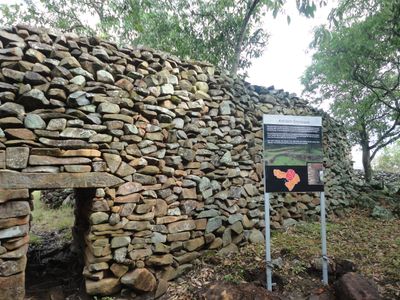
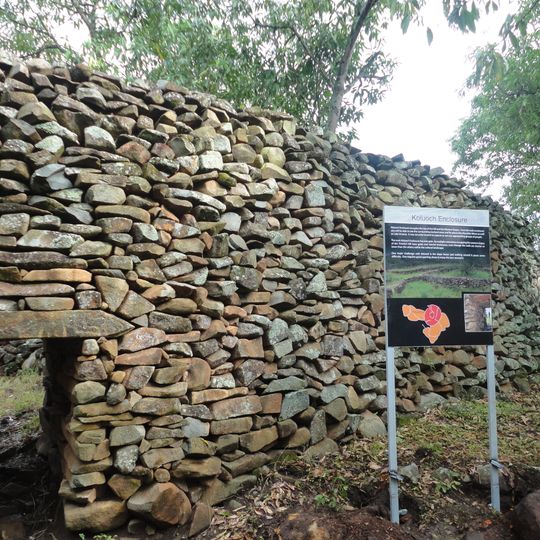
Thimlich Ohinga is a complex of stone-built ruins in Migori County, Kenya, on a gentle sloping hill. Its main enclosure has walls 1–3 m thick and 1–4.2 m high, made of undressed basalt blocks and rocks set without mortar; the densely packed stones interlock. The ovoid walls intersect in a curved, zigzag fashion with intermittent buttresses, and the site includes corridors, small enclosures, and circular hollows where houses stood.
Thimlich Ohinga was documented in the 1960s by Neville Chittick, then director of the British Institute of History and Archaeology in East Africa, and National Museums of Kenya researchers began work there in 1980. It was gazetted a Kenyan National Monument in 1981 under its new name, replacing Liare Valley. Occupation came in waves: Bantu-speaking inhabitants preceded Nilotic groups, and communities lived within the walls between the 15th and 19th centuries, repairing them. The last families left in the first half of the 20th century, when colonial administration brought peace and they moved to individual homesteads fenced with euphorbia.
In Dholuo, "Thimlich" means "frightening dense forest" and "Ohinga" means "large fortress". The site was gazetted as a National Monument in 1981 under this name, replacing "Liare Valley". Near the northeast side of the main enclosure, a mancala-like board game known locally as ajua is curved into the rock surface.
The site is best explored with a local guide who can explain the different wall sections and their purposes. Wear sturdy shoes and allow time for a leisurely walk around the structures and grounds.
Thimlich Ohinga is the largest of 138 stone-walled sites around the Lake Victoria region, which together hold 521 stone structures. Within the main enclosure, a mancala-like board game known locally as ajua is curved into a rock surface on the north-east side. Iron slag, tuyères and iron objects found in a partly walled area beside the main enclosure show that iron smithing took place here. Imported glass beads found on site indicate the settlement was part of long-distance trade networks.
The community of curious travelers
AroundUs brings together thousands of curated places, local tips, and hidden gems, enriched daily by 93,198 contributors worldwide.