Ol Doinyo Eburru, Active volcanic complex in Great Rift Valley, Kenya
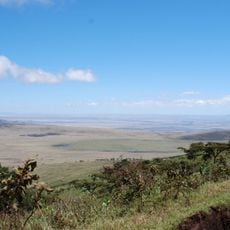
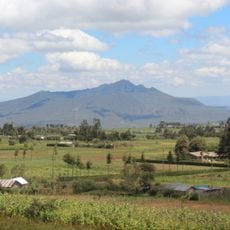
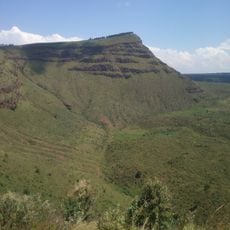
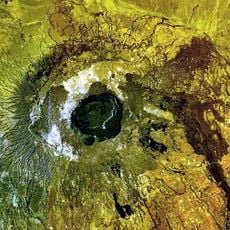
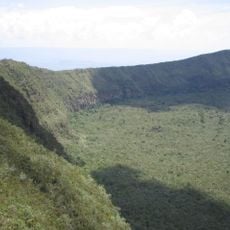
Ol Doinyo Eburru is a ridge-shaped volcanic complex in the Great Rift Valley, northwest of Lake Naivasha. Its east–west massif covers 470 square kilometres and has two summits, Eburru hill and West hill. The summit area holds more than fifty craters, from 200 metres to 1.25 kilometres across, along with small cones, domes and lava flows.
Eburru developed in three stages. The first, in the west, left only small pantelleritic lava outcrops. The second built the 19.5 km Waterloo Ridge on the east from pyroclastic eruptions along a fault zone. The third created craters, cones, domes and lava flows; the youngest formations are no more than a few hundred years old.
At Eburru village, where rainfall is scarce, residents pipe steam escaping from the ground, cool it and collect the condensed water in wells as a domestic supply. The method was shown in the 1987 NHK documentary series Dai Chikyu Kiko, episode 2, "The Earth Being Torn Apart".
The massif lies about 15 km northwest of Lake Naivasha and 20 km south of Lake Elmenteita, with Soysambu Conservancy to its north between the two lakes. Access is overland from the Naivasha side; the terrain is a ridge-shaped, eroded volcanic complex with fumaroles along fault lines, so footing is loose near craters and cinder cones. Steam vents and hot ground occur across the massif.
Eburru's youngest lava and ash beds are only a few hundred years old, and fumaroles still vent steam through cinder cones and craters along the massif's faults. At Eburru village, where rainfall is scarce, that steam is piped and cooled, and the condensate is stored in wells as drinking water; NHK filmed the practice for its 1987 series.
The community of curious travelers
AroundUs brings together thousands of curated places, local tips, and hidden gems, enriched daily by 93,861 contributors worldwide.