Bali Museum, Art and history museum in Denpasar, Indonesia
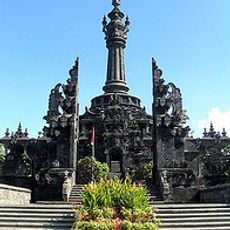
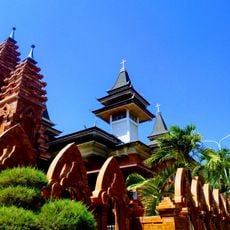
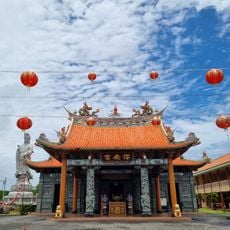
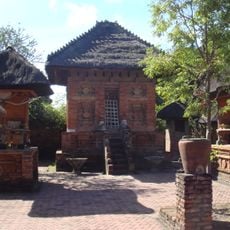
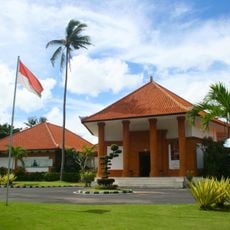
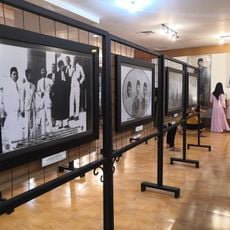
The Bali Museum stands on the eastern side of Taman Puputan in central Denpasar, near the site of the royal palace burned in 1906. Its walls and courtyards follow the palace as a model. Four main pavilions, named Tabanan, Karangasem, Buleleng and Timur, hold masks and instruments, sculptures and paintings, textiles, and archaeological finds.
The idea came from Th. A. Resink, who proposed a place to protect Balinese cultural objects; W.F.J. Kroon, assistant resident of South Bali and an architect, accepted it and built the ethnographic museum in 1910, starting with the Gedung Arca. Architects I Gusti Gede Ketut Kandel, I Gusti Ketut Rai and German Curt Grundler designed it, funded by the kings of Buleleng, Tabanan, Badung and Karangasem. It opened to the public on 8 December 1932.
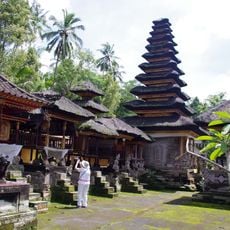
The museum's layout follows the island's regions: the Tabanan pavilion holds dance costumes, masks for topeng performances and keris used in Calonarang, while the Buleleng pavilion, styled after a north Balinese temple, keeps Balinese dress and traditional fans. The Badung pavilion stands by the tall bale kulkul, the slit drum once used to summon the community.
The museum stands on the eastern side of Taman Puputan, Denpasar's central square, on Jalan Mayor Wisnu; Pura Jagatnatha is just south and the Catur Muka statue in front. It is about 13 km, roughly 45 minutes by motor vehicle, from Ngurah Rai Airport. It opens Monday to Sunday, 08.00–15.00 WITA.
The museum's outer walls and courtyards copy the layout of the royal palace of Denpasar, burned down in 1906 during the Dutch intervention. Architect P.J. Moojen placed the complex on the eastern side of Taman Puputan, and the Badung pavilion stands near the tall bale kulkul, the traditional drum tower once used to gather the community.
The community of curious travelers
AroundUs brings together thousands of curated places, local tips, and hidden gems, enriched daily by 93,134 contributors worldwide.