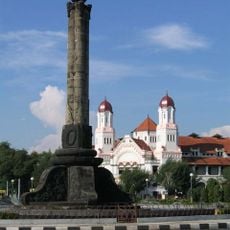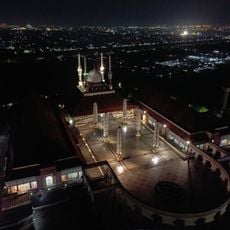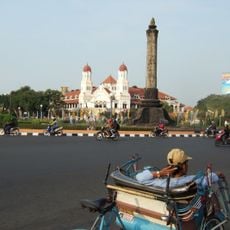
Masjid Kauman Semarang, Central mosque in Semarang City, Indonesia.
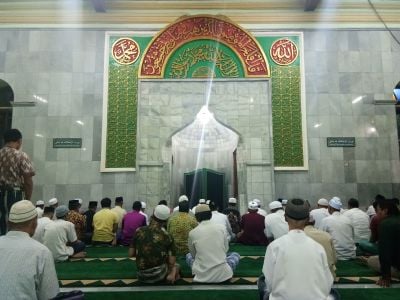
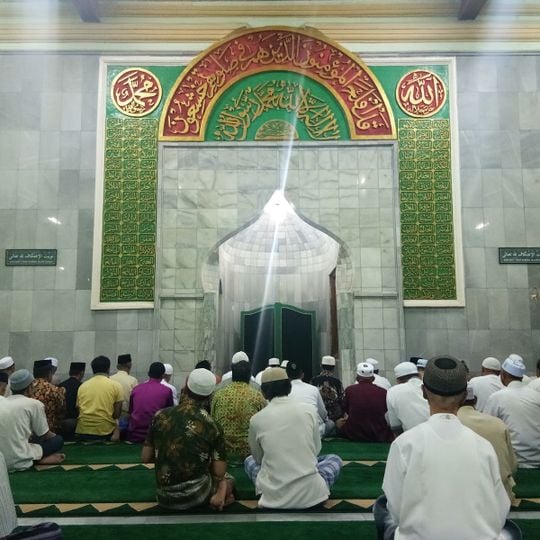
Masjid Agung Semarang, also called Masjid Kauman Semarang, is the fourth building on the site, with a tiered pyramidal roof supported by 36 pillars. The main prayer hall, reserved for men, holds a carved wooden minbar with hand-cut arches; an old clock still in use stands in one corner, and separate doors at the sides lead to the women's area.
A Javanese inscription in marble at the entrance gate records that the mosque was completed in 1170 AH (1749 CE), during the governorship of Nicolaas Hartingh and the regency of Kyai Adipati Suradimanggala. It replaced an earlier mosque badly damaged when the Chinese quarter was attacked in 1741. The Dutch architect J. A. van der Beeck restored it in 1889 and 1904 after fires.
The name comes from the Islamic community of this neighborhood who have used this place as a spiritual center for generations. Walking through, you notice intricate Arabic inscriptions and geometric patterns covering the surfaces, reflecting the religious purpose of the space.
The mosque stands at Jl. Alun-alun Barat No. 11, in Bangunharjo, Semarang Tengah, hemmed in by taller buildings. Since 2021 the Aloon-Aloon Masjid Agung square has reopened in front of it, where Pasar Yaik once stood. The main prayer hall is reserved for men; women enter through separate doors to the right and left.
The mosque is the only one in Indonesia known to have announced the country's independence publicly: about an hour after the Jakarta proclamation on Friday 17 August 1945, before the Friday prayer, dr. Agus spoke from the pulpit and told the congregation. He was afterwards pursued by Japanese troops and fled to Jakarta, where he died; in 1952 Sukarno came to pray and speak here.
The community of curious travelers
AroundUs brings together thousands of curated places, local tips, and hidden gems, enriched daily by 94,093 contributors worldwide.