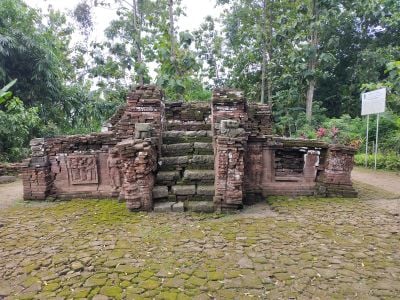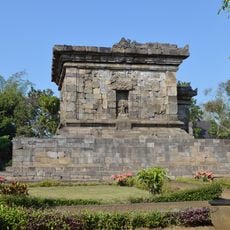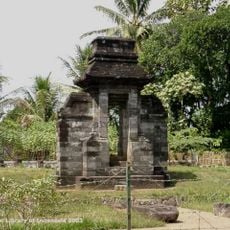
Candi Mirigambar, Hindu temple in Tulungagung, Indonesia.
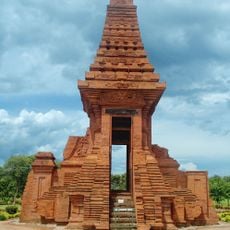
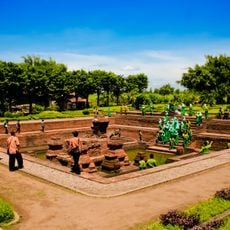
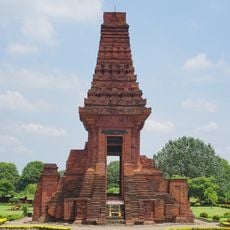
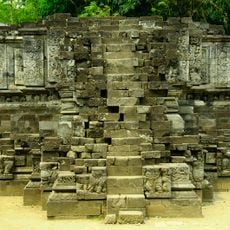
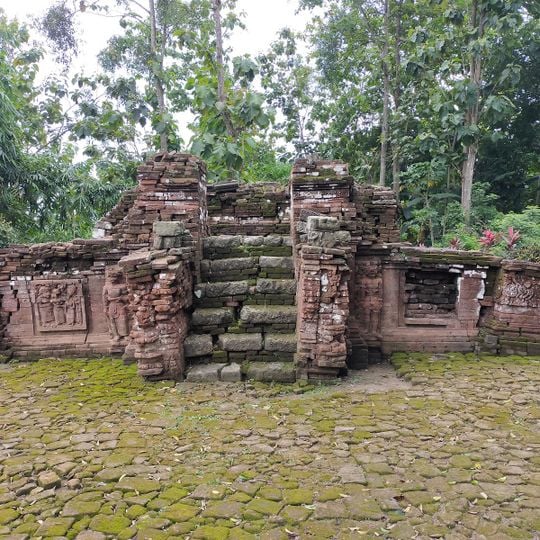
Candi Mirigambar is a red-brick temple facing west, built on a rectangular plan with three levels and seven steps. Its walls carry relief panels, including one on the first terrace showing four figures: a man in a tekes cap, two women, and a stout man with hair coiled on top. The base and stairway cheeks are carved with pilasters and, at the stair ends, seated lions with forelegs upright.
Candi Mirigambar is thought to date from the late 12th to the late 14th century, based on the Saka years 1214 and 1310 carved in relief on the temple. N.J. Krom discussed it in 1923 at the Inleiding Tot de Hindoe-Javaansche Kunst meeting, and a photo in volume 3 of that work shows the temple in the early 20th century, then called Candi Gambar, with its rear ruined and three relief panels on the south side.
The relief panels on the temple walls tell stories from the Panji tradition, which held great importance in ancient Javanese culture. These carvings show how local artists translated their own legends into stone.
The site stands adjacent to a soccer field near Mirigambar Village in Sumbergempol District. Finding the location requires following local directions, as the temple is not immediately visible from main roads.
The temple's stairway ends are carved as seated lions with their front legs upright, not the scroll volutes usual in Majapahit-period temples. On the north and south sides, a tall, upright man with curly hair gathered on top of his head, an open cloth and bracelets is carved amid scrolls, clouds, rocks and leaves suggesting dense forest.
The community of curious travelers
AroundUs brings together thousands of curated places, local tips, and hidden gems, enriched daily by 93,176 contributors worldwide.