薩文塔神廟, Hindu temple complex in Blitar, Indonesia
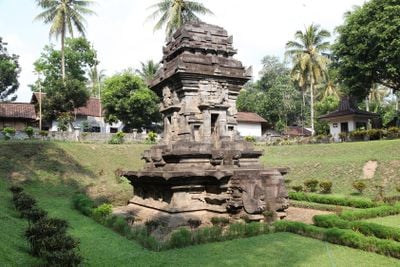
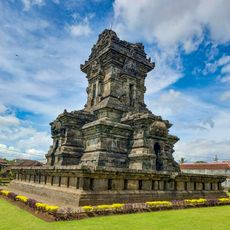
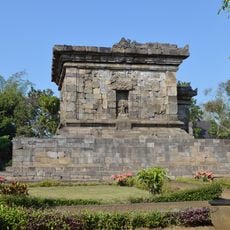
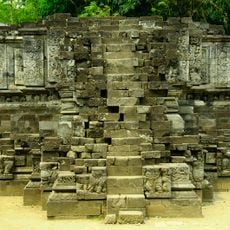
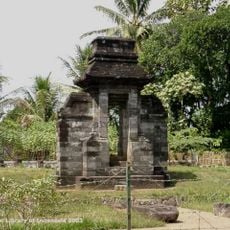
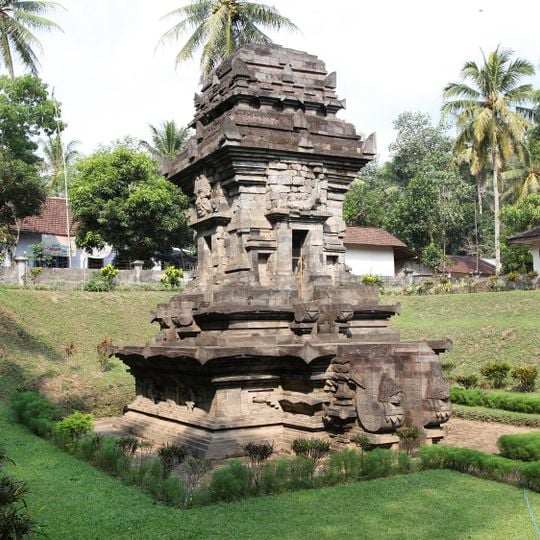
Candi Sawentar is a Hindu temple of dark grey andesite measuring 9.53 m long, 6.86 m wide and 10.65 m high. Its stepped base carries carved panels, and the recessed body has a west doorway flanked by makara ornaments on the stairway cheeks, with niches on each outer wall. It stands on a grassy slope east of Mount Kelud.
The temple was built during the early Majapahit period in the 13th century and served as a religious center in East Java. This era marked an important development in Hindu architecture throughout the region.
The name Sawentar derives from Lwa Wentar, mentioned in the Negarakertagama as a place visited by King Hayam Wuruk in 1361 during a royal tour. The temple's Hindu identity is confirmed by a fallen Garuda statue found inside the cella, the bird being Vishnu's mount.
The temple stands in Sawentar Village, Kanigoro District, about eight kilometres from the Garum road on the Malang–Blitar route, east of Mount Kelud. The approach road is badly potholed, so allow extra time. Sawentar I and II are separated by the dry Ngasinan river; Sawentar II is still under research and not yet restored.
The name Sawentar traces to "Lwa Wentar" in the Negarakertagama, which records King Hayam Wuruk visiting the place in 1361 CE during the month of Wesaka. Only this village preserves that toponym today, and brick foundations found around the temple show it once stood within a larger temple complex.
The community of curious travelers
AroundUs brings together thousands of curated places, local tips, and hidden gems, enriched daily by 93,182 contributors worldwide.