Snapper Rocks, Surf break at Rainbow Bay, Queensland, Australia
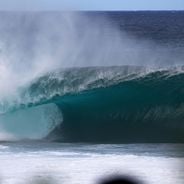
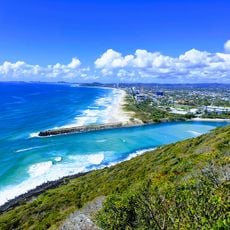
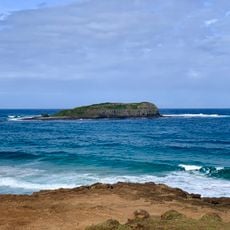
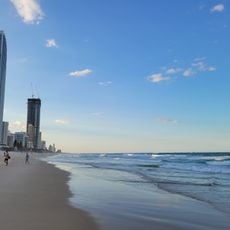
Snapper Rocks is a small rocky outcrop on the northern side of Point Danger, at the southern end of Rainbow Bay on the Gold Coast. Its point break forms the first section of the man-made Superbank, which runs about 2 km through Rainbow Bay, Greenmount, Coolangatta and Kirra. Sand pumped north from the Tweed River mouth since 1995 has built the sandbar up.
Snapper Rocks was named after the HM Colonial Cutter Snapper, whose captain W.L. Edwardson passed Point Danger in July 1822. In 1956 Jack Evans built the Snapper Rocks Sea Baths with an adjacent shark pool, and later that year two bottlenose dolphins caught in Terranora Creek were put on show there; the pools moved to the Tweed River mouth near Duranbah beach in 1961, and only remnants remain. Since 1995 the Tweed River sand bypass system has pumped sand from the river mouth to beaches to the north, building the Superbank between Snapper Rocks and Kirra.
Since 2002, Snapper Rocks has hosted a leg of the ASP World Tour, sponsored by the surf company Quiksilver. The event brings top professional surfers to the point break at the southern end of Rainbow Bay. On good days, more than 500 surfers can be counted along the 2 km stretch of the Superbank.
The wave breaks over rocks at the northern tip of Point Danger, at the southern end of Rainbow Bay. On a good day over 500 surfers can be counted along the 2 km stretch, so expect multiple drop-ins. The Superbank runs from Snapper Rocks Point through Rainbow Bay, Greenmount, Coolangatta and Kirra.
The wave is man-made in origin: since 1995 the Tweed River sand bypass has pumped sand from the river mouth northwards, building the sandbar surfers call the Superbank. It runs about 2 km from Snapper Rocks through Rainbow Bay, Greenmount, Coolangatta and Kirra.
The community of curious travelers
AroundUs brings together thousands of curated places, local tips, and hidden gems, enriched daily by 92,823 contributors worldwide.