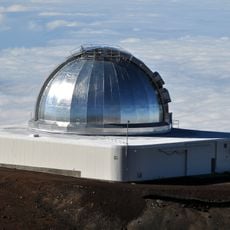
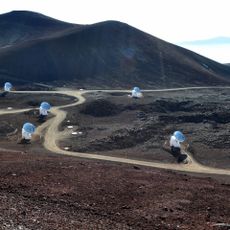
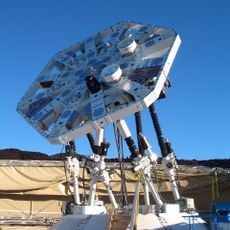
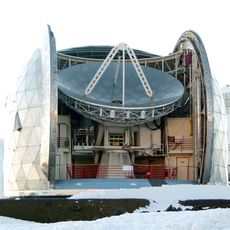
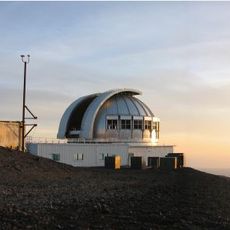
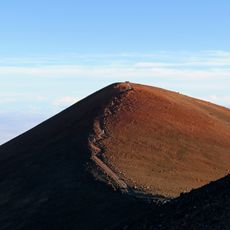
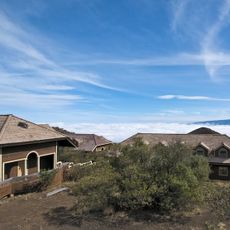
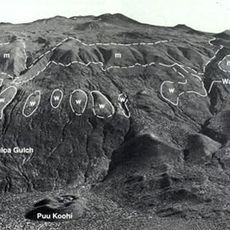
Canada–France–Hawaii Telescope, Optical telescope facility on Mauna Kea summit, Hawaii, US
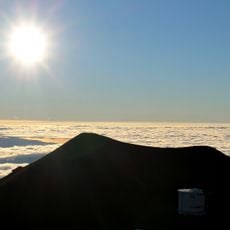
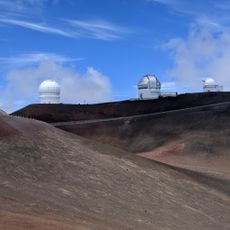
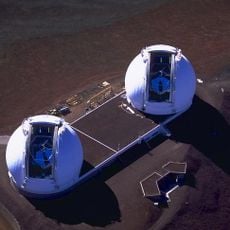
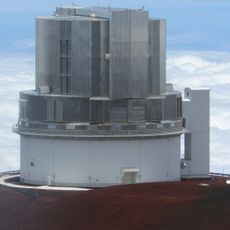
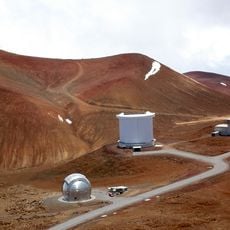
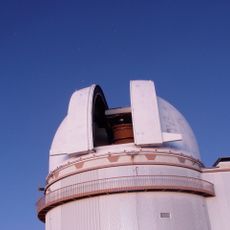
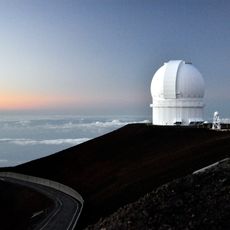
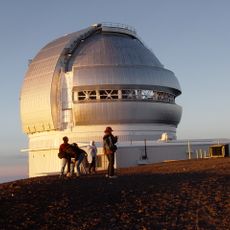
The Canada-France-Hawaii Telescope is a research facility on Mauna Kea's summit featuring a 3.6-meter optical and infrared telescope positioned at approximately 4,200 meters elevation. The installation enables observations through specialized instruments that detect different wavelengths of light from space.
Built in 1977 by a non-governmental corporation of Canadian, French and University of Hawaii astronomers, the telescope saw first light on 6 August 1979, then the sixth-largest optical telescope in the world. In 1999 astronomer Vladimir Krasnopolsky used it to confirm methane in the Martian atmosphere. A proposed Maunakea Spectroscopic Explorer upgrade is on hold, and the telescope is to keep operating into the 2030s.
The name marks a tripartite agreement between the University of Hawaii at Manoa, Canada's National Research Council and France's CNRS; China, Taiwan, Brazil and Korea later joined as associate partners, and observing time is shared among scientists from all seven countries. The public-outreach site "Hawaiian Starlight", run with Coelum Astronomia, distributes high-quality CFHT images and a yearly calendar.
Observing time is allocated to scientists from the seven partner countries, while European Union astronomers can apply through the OPTICON access programme. The telescope sits at 4,204 m near Mauna Kea's summit, so the thin air demands acclimatisation before any work on site.
The MegaCam instrument captures sky images with a resolution of 378 megapixels across a field of view spanning one degree. This combination of high resolution and wide viewing angle allows astronomers to gather large amounts of data efficiently.
The community of curious travelers
AroundUs brings together thousands of curated places, local tips, and hidden gems, enriched daily by 94,243 contributors worldwide.