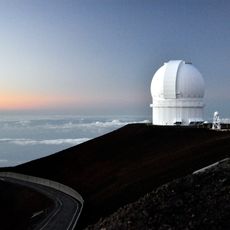
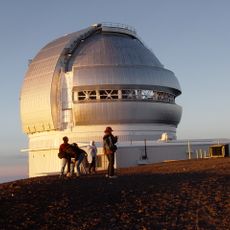
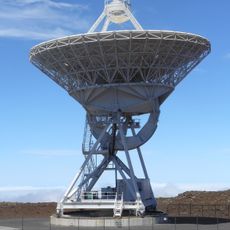
Submillimeter Array, Radio interferometer at Mauna Kea Observatories, United States.
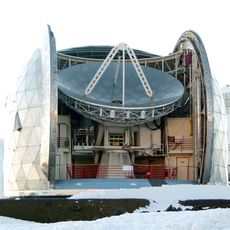
The Submillimeter Array is a collection of eight 6-meter antennas positioned at approximately 4000 meters elevation that work together as a single telescope system. These antennas can be spread across significant distances to capture fine details of distant cosmic objects.
The SMA project began in 1983 under Irwin Shapiro, then director of the Smithsonian Astrophysical Observatory. The design first called for six antennas; in 1996 the Academia Sinica Institute of Astronomy and Astrophysics joined, funding two more antennas and a larger correlator. The antennas were built at Haystack Observatory in Massachusetts, shipped to Hawaii and reassembled in a summit hangar. The array was dedicated on November 22, 2003.
The array is jointly run by the Smithsonian Astrophysical Observatory and Taiwan's Academia Sinica Institute of Astronomy and Astrophysics, which joined in 1996 and funded two extra antennas. Those two dishes are known as SMART, the Sub-Millimeter ARray of Taiwan. The name refers to wavelengths just under a millimetre, between infrared and microwave.
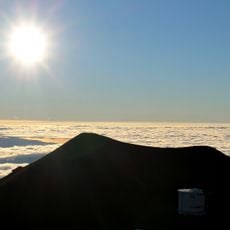
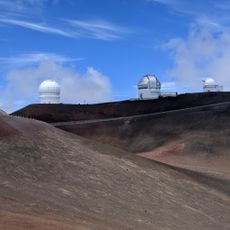
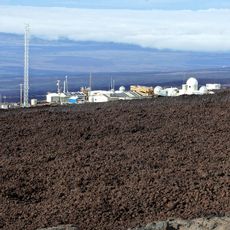
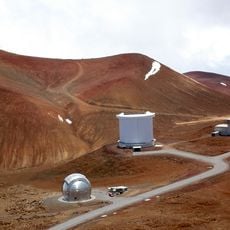
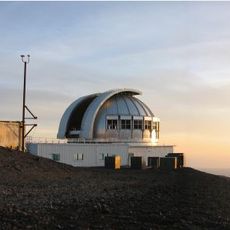
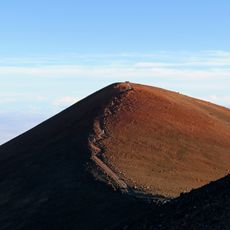
The SMA is a working research facility, not a visitor site, so it cannot be toured. Its eight antennas sit on pads forming four Reuleaux triangles, and a custom transporter moves them roughly quarterly between subcompact, compact, extended and very extended layouts. The site lies on a lava field about 140 meters below Mauna Kea's summit, just northwest of the saddle between the cinder cones Pu'u Poli'ahu and Pu'u Hauoki.
The antennas' 6-meter primary mirrors are made of 72 machined cast aluminum panels, each about 1 meter wide and shaped to an accuracy of 6 microns. Aluminum was chosen over lighter carbon fiber because heavy snow and windblown volcanic dust could damage fragile carbon fiber panels.
The community of curious travelers
AroundUs brings together thousands of curated places, local tips, and hidden gems, enriched daily by 94,483 contributors worldwide.