AMiBA, Radio telescope in Hawaii County, US
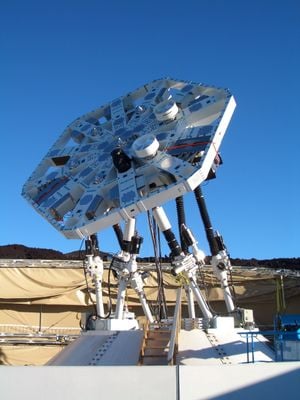
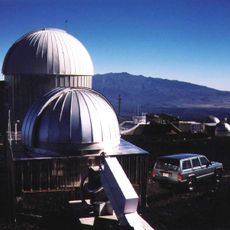
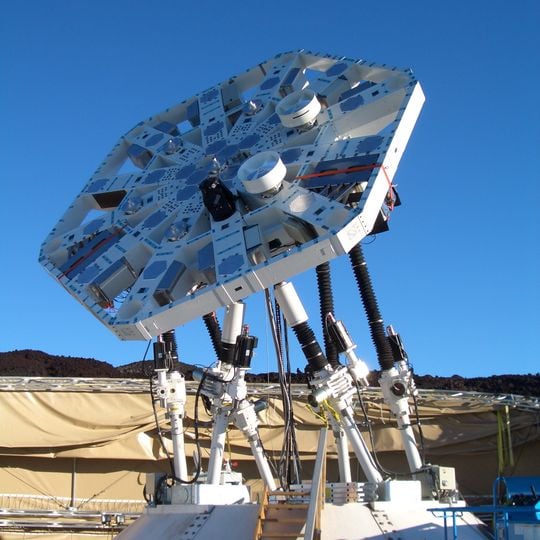
AMiBA is a radio interferometer on Mauna Loa, Hawaii, at 3,396 m. Its 13 Cassegrain dishes sit on a tilted hexagonal platform carried by a 6 m carbon-fibre hexapod mount, whose six black corrugated legs rise from white cylindrical bases on mechanical joints. A retractable shelter of seven steel trusses and PVC fabric covers the array.
AMiBA began in 2000 with four years of funding from Taiwan's Ministry of Education; a two-element prototype was set up on Mauna Loa in 2002. The hexapod mount arrived in 2004 and the platform in 2005, and the first seven dishes saw first light in September 2006 by observing Jupiter. It was dedicated to Yuan-Tseh Lee in October 2006, upgraded to thirteen 1.2 m dishes in 2009, and ceased operations in 2021.
Scientists from Taiwan, Australia, and the United States work together at this facility to investigate the cosmic microwave background radiation. Their collaboration shows how researchers across different countries unite to explore deep questions about the universe.
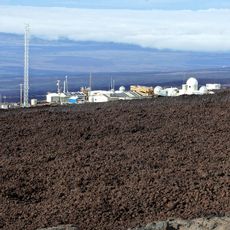
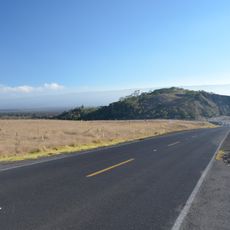
The array stands at 3,396 m on Mauna Loa, reached by a steep road; the thin air makes exertion harder, so allow time to acclimatise. The site is a working observatory, not a visitor attraction, and the hexapod has anticipated no further observations since operations ceased in 2021. Access and any viewing are arranged through the operating institutions, not on site.
The facility uses a technique called the Sunyaev-Zel'dovich effect to examine distant galaxy clusters and measure their distance. This method has provided new ways to understand the structure of the universe.
The community of curious travelers
AroundUs brings together thousands of curated places, local tips, and hidden gems, enriched daily by 94,356 contributors worldwide.