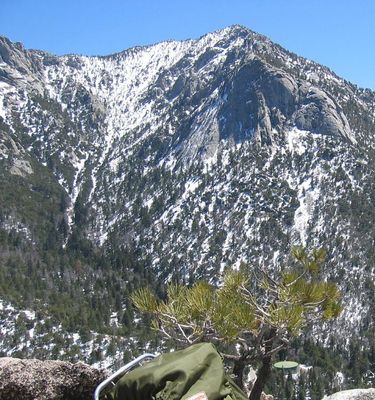
Tahquitz Peak, Granite summit in San Jacinto Mountains, California.
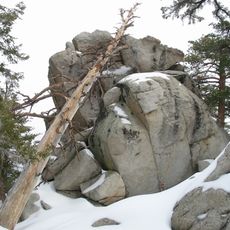
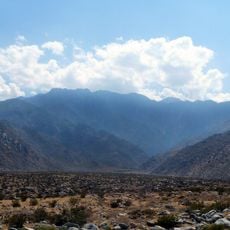
Tahquitz Peak is a granite summit in the San Jacinto Mountains that rises to about 8,846 feet above sea level. The western slope features a steep granite face that dominates the landscape and offers various hiking and climbing routes.
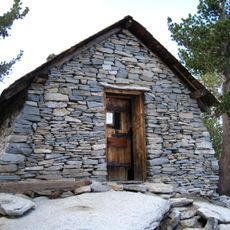
The name Tahquitz first appeared in print on a 1901 USGS San Jacinto topographical map, taken from the luminous spirit recognized by Cahuilla and Kumeyaay groups. In June 1935 Sierra Club member Jim Smith found the rock, and the first fifth-class ascent, "The Trough" (5.4), followed in August 1936. In 2018 the Cranston Fire burned the south face and threatened the lookout.
The name comes from Tahquitz, a luminous spirit recognized by Southern California tribes including the Agua Caliente and Morongo Bands of Cahuilla Indians, the Cabazon and Ramona Bands, and Kumeyaay groups in San Diego County. It first appeared in print on a 1901 USGS San Jacinto topographical map.
The most popular routes are the South Ridge and Devil's Slide Trail, both moderate in difficulty and best suited for experienced hikers. Before visiting, check weather conditions and bring plenty of water, as the summit area is fully exposed to the elements.
The Yosemite Decimal System was worked out at Tahquitz by Sierra Club Rock Climbing Section members in the 1950s. Royal Robbins, Don Wilson and Chuck Wilts replaced the old easy-moderate-hard labels with a 5.0 to 5.9 scale, and Mark Powell carried it to Yosemite, where it became the US standard by the early 1960s.
The community of curious travelers
AroundUs brings together thousands of curated places, local tips, and hidden gems, enriched daily by 92,652 contributors worldwide.