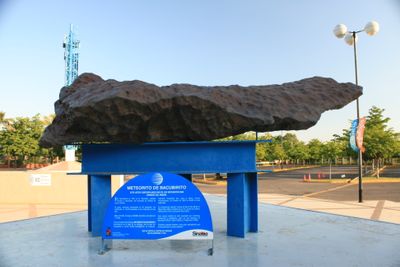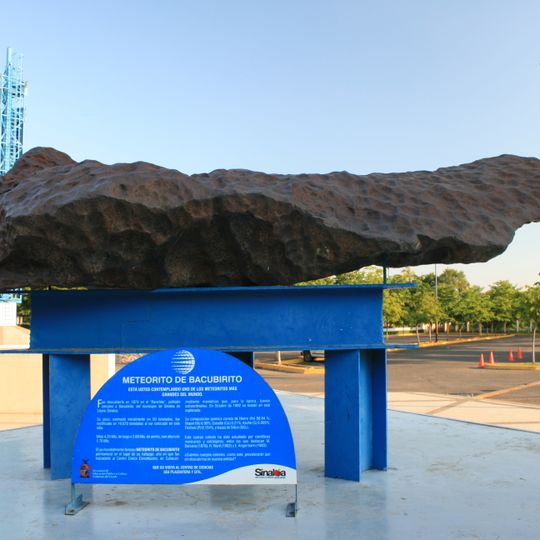
Bacubirito Meteorite, Iron meteorite at Science Center in Culiacán, Mexico.
The Bacubirito meteorite is an iron meteorite on display inside the Centro de Ciencias de Sinaloa in Culiacán. It measures about 4.25 m long, 2 m wide and 1.75 m high, with an ear-like shape that made its mass hard to estimate. A scanner used by UAS and UNAM researchers put it at 20 tonnes. Its surface is silver-grey and leaden, and it is 88.94% iron with 6.98% nickel.
Peasants found the iron mass in 1863 at El Camichín, in the El Ranchito community of Sinaloa municipality, and it took the name of nearby Bacubirito. In 1959 it was moved from its crater to the Centro Cívico Constitución in Culiacán, where it stayed until 1992, when Antonio Mora Stephenson had it placed at the Centro de Ciencias de Sinaloa. In 2013 a proposal was submitted to UNESCO to declare it a World Heritage Site on the 150th anniversary of the find.
The name comes from Bacubirito, the Sinaloa village near where farmers found it in 1863, though it lay at El Camichín in the El Ranchito area. In 2013, for the 150th anniversary of the find, a proposal was submitted to UNESCO to declare it a World Heritage Site. Visitors today see it indoors at the Centro de Ciencias de Sinaloa.
The meteorite is now kept inside the Centro de Ciencias de Sinaloa in Culiacán, not on the outdoor esplanade where it stood until recently. Look for it in the museum's interior rather than the entrance plaza. Because it spent decades outdoors, it shows oxidation, so check current access conditions before travelling.
Its ear-like shape, about 4.2 m long, 2 m wide and 1.75 m high, made its mass hard to pin down: early estimates reached 50 tonnes, and only a scanner study by UAS and UNAM researchers settled on 20 tonnes. That figure makes it the longest meteorite yet found.
The community of curious travelers
AroundUs brings together thousands of curated places, local tips, and hidden gems, enriched daily by 92,939 contributors worldwide.