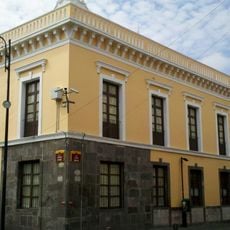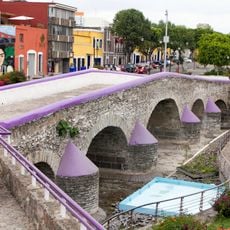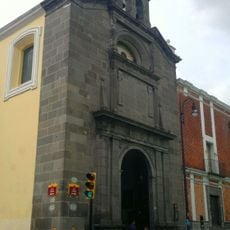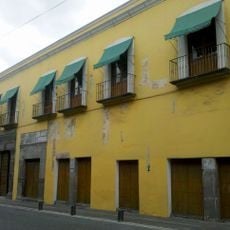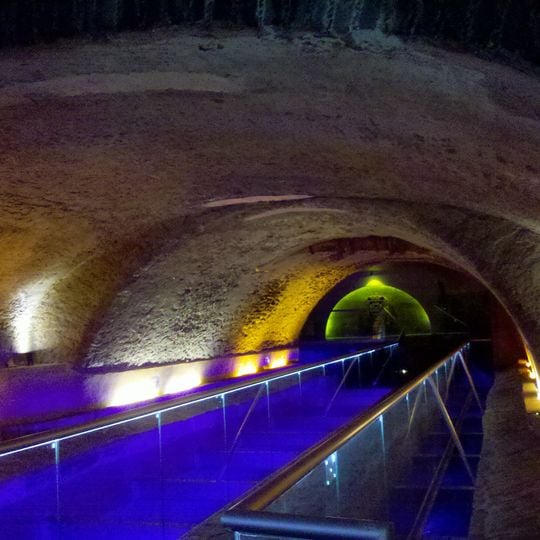
Bubas Bridge, Colonial bridge in Puebla, Mexico.
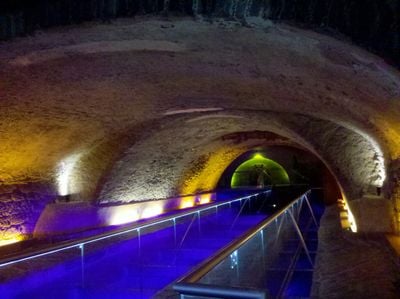
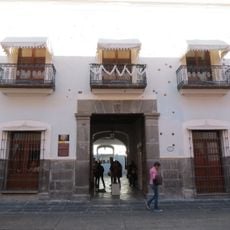
Bubas Bridge is a 17th-century brick arch with a barrel vault, built in 1682 of lime and stone to link the upper and lower neighbourhoods of Puebla. It was widened in 1839 and 1886, when an iron railing was added, and later buried when the San Francisco River was vaulted over. Excavated in 2014, it now lies in an underground passage entered from the former Toro house.
The bridge was rebuilt in 1682 alongside the Hospital de Bubas, founded by Anastasio Luis Salcedo Coronel y Benavides to treat patients with syphilis, then called bubas. It was built of lime and stone, with the royal arms on one side and the city's arms on the other. It was widened in 1839 and again in 1886, when an iron railing was added.
The bridge's name comes from the Hospital de las Bubas, founded in 1682 by Anastasio Luis Salcedo Coronel y Benavides to treat patients with the French disease. It later took the names Puente de los Soldados and Puente del Toro, and in 1886 an inscription on its south railing read "Puente Motolinía. Ampliado en 1886". Today it forms part of the tourist corridor "Los Secretos de Puebla".
Access is typically through guided tours that lead visitors through the underground chambers and explain the layout and structure. Wear comfortable shoes, as the ground can be uneven and the passages have tight spots that require careful navigation.
What makes this passage notable is that it is among the oldest known infrastructure projects in Mexico, showing how early colonial planners designed river crossings. Its rediscovery after centuries of being lost stands as a rare example of urban archaeology that restored a hidden part of the city's past.
The community of curious travelers
AroundUs brings together thousands of curated places, local tips, and hidden gems, enriched daily by 93,761 contributors worldwide.