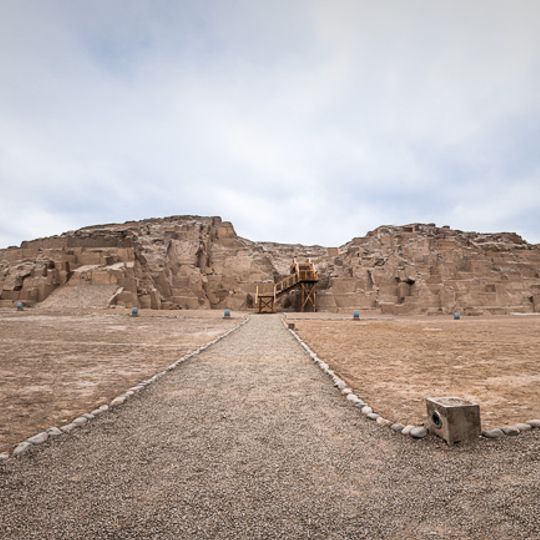
Mateo Salado, Archaeological site in Lima, Peru
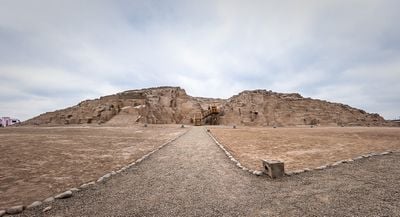
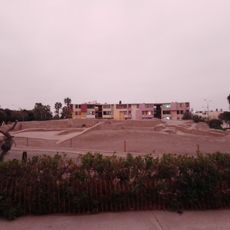
Mateo Salado is an archaeological complex of five stepped, flat-topped pyramids built from adobe, covering 16.4 hectares in Lima near the Plaza de la Bandera. The photograph shows a wide earthen structure with rough rectangular sections, a wooden staircase near the centre and a sloped ramp on the left.
The complex originated around 900 years ago when the Ichma civilization built it as a ceremonial center. In the 15th century, the Inca Empire expanded into the region and annexed the site into their territory.
The name Mateo Salado is a Spanish rendering of Matheus Salade, a French hermit who lived alone among the pyramids around 1560. Accused of heresy for speaking against priests' privileges, he was burned at the stake on 15 November 1573 in the first auto-da-fé held in Lima's Plaza Mayor, the first victim of the Inquisition in Peru. The complex's original name remains unknown; in the 18th century it was called Huacas de Ríos, later Cinco Cerritos.
Daytime visits work best when sunlight illuminates the adobe structures and reveals their details clearly. Wearing comfortable shoes is advisable as the terrain is uneven with areas to explore on foot.
The site takes its name from Matheus Salade, a French hermit who made his home in these ruins during the 1500s. His story ended darkly when Spanish Inquisitors executed him in 1573 for his beliefs.
The community of curious travelers
AroundUs brings together thousands of curated places, local tips, and hidden gems, enriched daily by 93,802 contributors worldwide.