Trinity Parish, Episcopal church in St. Augustine, Florida, US
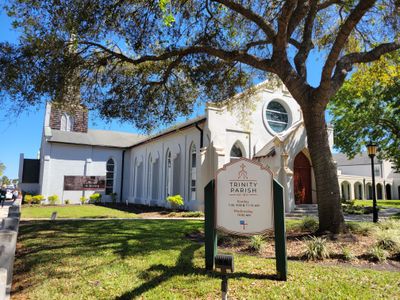
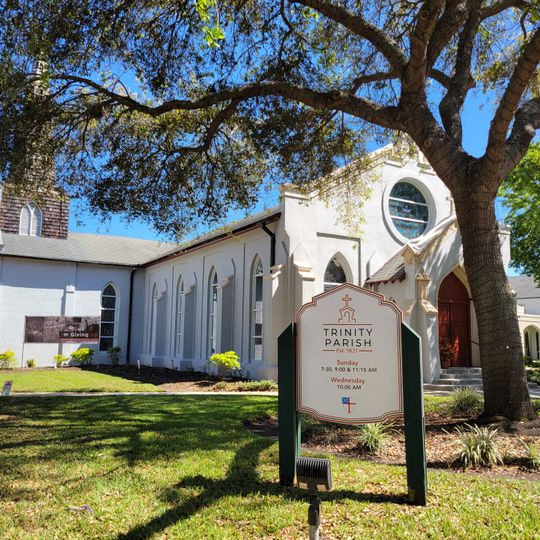
Trinity Parish stands at the corner of King and St. George Street on the plaza in downtown St. Augustine. The present church, a cruciform neo-Gothic building seating 300, opened for services on January 17, 1903, replacing an 1831 coquina structure. Its white facade has a round window with a cross-shaped mullion, a pointed-arch window and a dark double door under a gabled portico; a side wing holds five narrow pointed-arch windows and a square louvered tower stands at the left.
Trinity Parish was founded in 1821, soon after Florida became a United States territory, and was one of the seven original parishes when the Episcopal Diocese of Florida joined the General Convention in 1838. The first church, begun in 1830 and opened for services on June 30, 1831, was built of coquina, the local shell stone also used for the Castillo de San Marcos, and measured 36 by 50 feet. Bishop Nathaniel Bowen of South Carolina consecrated it on June 5, 1834. In 1902 the building was enlarged into the cruciform neo-Gothic church that opened on January 17, 1903.
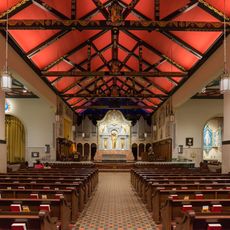
The name Trinity Parish reflects the church's dedication to the Holy Trinity. Since 1859 its windows have served a teaching purpose: the four Evangelists above the old King Street entrance are the only windows meant to be read from outside. Ten windows, including the altar triptych, were made by Franz Mayer & Co. of Munich; one is by Louis Comfort Tiffany.
Trinity Parish stands at the corner of King and St. George Street, facing the plaza in downtown St. Augustine. The congregation's parking lot was acquired in the 20th century and sits beside the church complex, which also includes Trinity Hall, a 6,000 sq ft building at the adjacent former Woolworths/Walgreens site. The four Evangelist windows at the old King Street entrance are the only ones meant to be read from outside.
The four Evangelists — Matthew, Mark, Luke and John — accenting the old King Street entrance are the only windows designed to be viewed from outside the church. Above that door, a round "Descending Dove" pane completes the group. Ten of the windows, including the triptych above the altar, came from Franz Mayer & Co. of Munich; one is by Louis Comfort Tiffany.
The community of curious travelers
AroundUs brings together thousands of curated places, local tips, and hidden gems, enriched daily by 92,757 contributors worldwide.