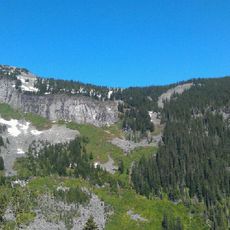
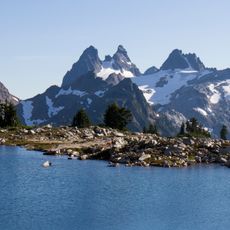
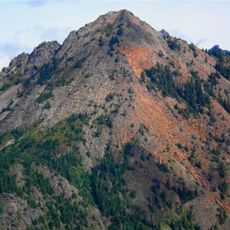
Stampede Pass, Rail mountain pass in Washington, United States
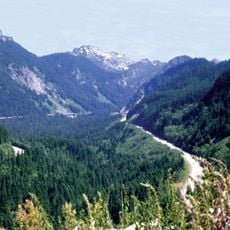
Stampede Pass is a 3,672-foot (1,119 m) mountain pass in the Cascade Range of Washington, southeast of Seattle and east of Tacoma. No paved road crosses it; its transportation role is almost entirely rail. About two miles (3 km) south of the pass lies the 1.86-mile (3.0 km) Stampede Tunnel, just below 2,850 feet (870 m), operated by BNSF Railway.
Northern Pacific Railway completed the original Stampede Tunnel in 1888, creating the first rail connection through the Cascades between eastern and western states. This breakthrough played a key role in linking regions separated by mountains.
The name is tied to the Northern Pacific's race to find a Cascade crossing before it lost its federal land grant. In January 1881 civil engineer Virgil Bogue led a party from McClintock's near Enumclaw, cutting trail through brush and fallen logs; camps were numbered and named along the way, such as Eagle Gorge for an eagle seen overhead and Canoe Creek for a failed canoe attempt.
No paved road crosses Stampede Pass; the pass is reached only by rail, and the area is off-limits to public vehicles. The 1.86-mile Stampede Tunnel runs just south of the pass at just below 2,850 feet. The line is operated by BNSF as part of its Northern Transcon route.
The pass was found by Northern Pacific civil engineer Virgil Bogue, whose January 1881 report describes cutting trail through brush and crusted snow from McClintock's near Enumclaw. His party named camps along the way, including Eagle Gorge after an eagle seen overhead and Canoe Creek after a failed canoe attempt.
The community of curious travelers
AroundUs brings together thousands of curated places, local tips, and hidden gems, enriched daily by 93,777 contributors worldwide.