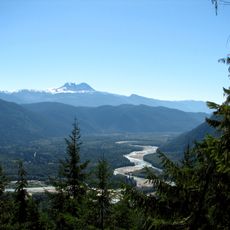
Black Tusk, Volcanic mountain in Garibaldi Provincial Park, Canada.
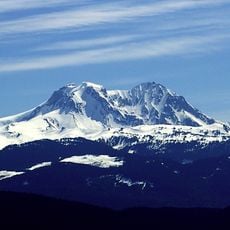
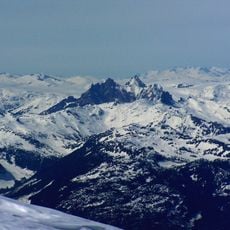
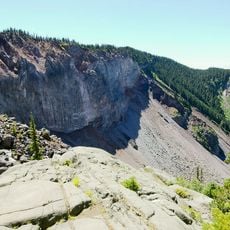
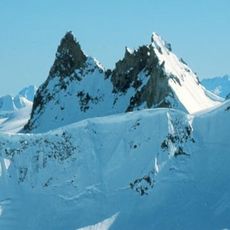
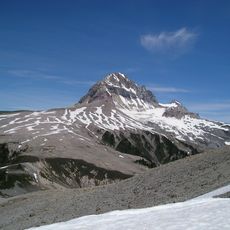
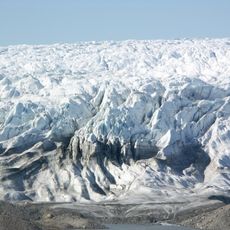
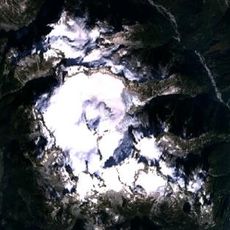
Black Tusk is a pinnacle of black volcanic rock in Garibaldi Provincial Park, reaching 2,319 m. Its upper spire is the eroded lava core of an andesitic stratovolcano, left standing after the surrounding cinder wore away. Two glaciers occupy cirques on the northeastern and northwestern flanks below the pinnacle, their ice covered in rocky debris shed by the crumbling rock.
Black Tusk is the eroded remnant of an andesitic stratovolcano that formed between about 1.3 and 1.1 million years ago. Glacial dissection followed, then renewed volcanism built the lava dome and flow at its summit around 170,000 years ago. Natural Resources Canada describes it as perhaps the conduit of a cinder-rich volcano whose loose cinder eroded away, leaving the hard, friable black lava core. William J. Gray's party made the first ascent in 1912.
The mountain marks the traditional border between the Squamish and Lil'wat nations. The Squamish name T'ákt'akmúten tl'a Ín7inyáx̱a7en means "Landing Place of the Thunderbird", referring to the supernatural Ín7inyáx̱a7en; the jagged shape and black colour are said to come from its lightning, as at Mount Cayley.
Access to this mountain requires a free Day-Use Pass, and the trail covers about 29 kilometers taking up most of a full day. The best time to visit is from July through October when most of the snow has melted.
The true summit, about a metre higher than the south summit, lies just north across a precipitous drop and is rarely climbed: reaching it requires a 10 m rappel into a notch and a loose reascent up crumbling lava. On the north side stands the isolated rock formation known as the Bishop's Mitre, rumoured to be unclimbed.
The community of curious travelers
AroundUs brings together thousands of curated places, local tips, and hidden gems, enriched daily by 93,085 contributors worldwide.