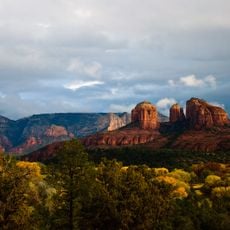
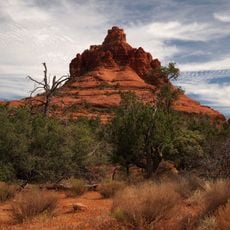
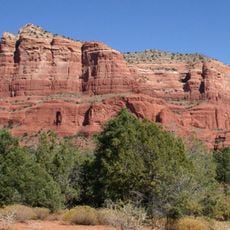
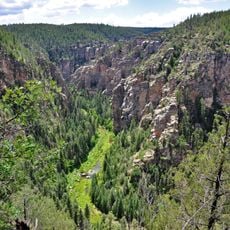
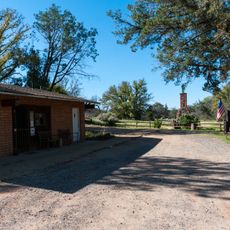
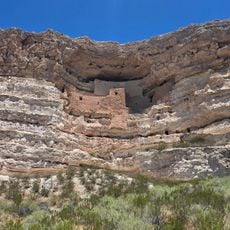
Montezuma Well, Natural limestone sinkhole near Lake Montezuma, Arizona, United States.
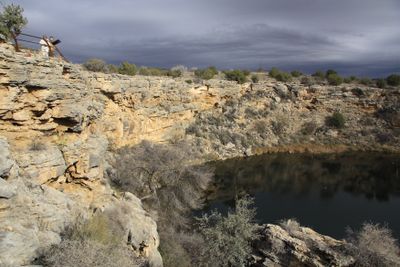
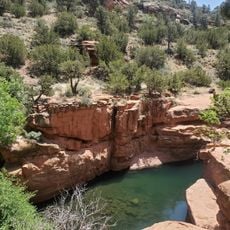
Montezuma Well is a natural limestone sinkhole near Lake Montezuma, Arizona, 386 feet across from rim to rim, with layered pale tan walls dropping to a dark pool. About 1,500,000 US gallons of water rise daily from an underground spring, and the ruins of prehistoric dwellings sit in and around the rim.
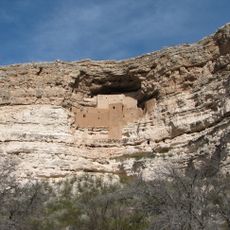
Archaeological evidence shows humans in the Verde Valley for at least 10,000 years, with permanent settlement from around 600 CE. Between 700 and 1425 CE the Southern Sinagua and other cultures farmed using the well's outflow; from about 700 CE a canal nearly seven miles long diverted water to lateral ditches supplying up to 60 acres. A Hohokam-style pithouse dates to about 1050 CE, and more than 50 rooms lie within the park.
The name "Montezuma" is a misnomer: the Aztec emperor had no link to the site or its early inhabitants. The Yavapai call the Well ʼHakthkyayva and consider it sacred, the place through which they emerged into the world. A prehistoric ditch, its walls hardened by lime into a cement-like coating, runs near the picnic ground.
Visit during daylight hours to safely explore the trails and viewpoints around the sinkhole's rim. The paths are marked and relatively accessible, though walking around the natural formation requires some physical comfort on uneven terrain.
The water contains high levels of dissolved carbon dioxide that prevent fish from surviving, yet it hosts several species found nowhere else. This unusual chemistry has created an ecosystem unlike any other place on Earth.
The community of curious travelers
AroundUs brings together thousands of curated places, local tips, and hidden gems, enriched daily by 93,141 contributors worldwide.