Holy Trinity Cathedral, Port-au-Prince, Episcopal cathedral in downtown Port-au-Prince, Haiti
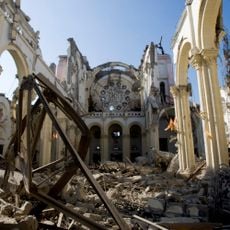
Holy Trinity Cathedral stood at the corner of Avenue Mgr Guilloux and Rue Pavée in downtown Port-au-Prince as the main church of the Episcopal Diocese of Haiti. The complex also housed trade schools, primary schools and music academies. The cathedral was razed after the 12 January 2010 earthquake.
The cathedral was built between 1924 and 1929 at the corner of Rue Monseigneur-Guilloux and Rue Pavée. In 1947 Bishop Alfred Voegeli invited eight Haitian naive artists to paint frescoes in the church. The building was destroyed in the earthquake of 12 January 2010, and by 2017 reconstruction had not begun.
The murals were painted by Philomé Obin, Castera Bazile, Rigaud Benoit, Gabriel Leveque, Adam Léontus, Wilson Bigaud, Jasmin Joseph and Préfète Duffaut, working under DeWitt Peters and Selden Rodman of the Centre d'Art. Bishop Alfred Voegeli invited them to try fresco painting between 1947 and 1950. Bazile's Ascension filled the apse; Obin painted the Last Supper and the Crucifixion. Later Fernand Pierre, Auguste Toussaint and Seymour Bottex added work.
The cathedral stood at the corner of Avenue Mgr Guilloux and Rue Pavée in downtown Port-au-Prince. The building was razed after 12 January 2010, so there is no interior to visit; the site is a cleared lot. Three of the fourteen murals survived and are held by the Episcopal Diocese and the Smithsonian.
The Rieger organ, installed in 1961, was considered one of the largest in the Caribbean. It was crushed when debris collapsed during the 12 January 2010 earthquake, the same event that left only three of the fourteen murals intact.
The community of curious travelers
AroundUs brings together thousands of curated places, local tips, and hidden gems, enriched daily by 92,812 contributors worldwide.