Le Marron Inconnu, Slavery memorial in Port-au-Prince, Haiti.
Le Marron Inconnu is a bronze statue, 3.60 metres long and 2.40 metres high, completed by Haitian architect Albert Mangonès on 22 September 1967. It shows a near-naked fugitive kneeling on one knee, torso arched, a broken chain on his left ankle, blowing a conch shell held to his lips while his right hand holds a machete by his ankle. It stands across from the National Palace in central Port-au-Prince.
Albert Mangonès completed the bronze statue on 22 September 1967, placing it across from the National Palace in central Port-au-Prince. It recalls the 1791 uprising in the colony of Saint-Domingue against French rule, the call to revolt that opened the Haitian Revolution. Mangonès set a passage from 1 Maccabees 14:3-9 of the Jerusalem Bible in copper letters on one of the two concrete panels guarding the square's eternal flame of freedom.
The figure is called Nèg Mawon in Haitian Creole, "the maroon man", and the conch shell he blows is the lambí, the signal of the 1791 uprising in Saint-Domingue. The broken chain on his left ankle marks the escape from slavery. The statue stands for the maroons, fugitives who left the plantations and resisted from the hills.
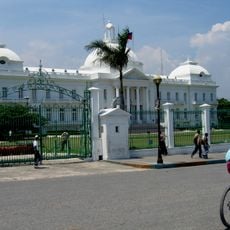
The monument stands in the downtown area across from the former National Palace and is open to the public. The location sits in an active part of the city where it is easily walkable, though visitors should remain aware of their surroundings as is typical for this neighborhood.
The United Nations selected this monument in 1989 as a symbol for stamps commemorating Article 4 of the Universal Declaration of Human Rights. This international recognition made it a rare Haitian work with global visibility.
The community of curious travelers
AroundUs brings together thousands of curated places, local tips, and hidden gems, enriched daily by 92,789 contributors worldwide.