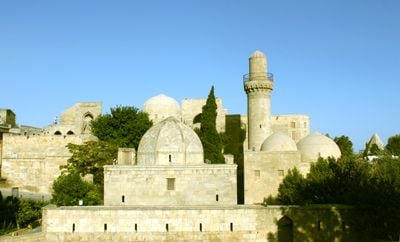
Palace of the Shirvanshahs, Medieval palace complex in Old City, Azerbaijan
The Palace of the Shirvanshahs is a limestone complex on the highest part of Icherisheher hill, covering about one hectare. It includes the main palace, the Divankhana, the Shirvanshahs' tomb, the Shah Mosque with its minaret, Seyid Yahya Bakuvi's mausoleum, a bath house and an ovdan. The buildings, erected from the 13th to the 16th century, share cubic volumes, domes and carved stone walls.
Construction began under Shirvan ruler Ibrahim I (1382–1417) and continued under Khalilullah I (1417–1465), whose name appears on the tomb (839 AH, 1435–36) and the Shah Mosque minaret (845 AH, 1441–42). After Shah Ismail I took Baku in 1501, the palace was destroyed and later stood empty. In 1578 the Ottomans added Murad's Gate, and in 1723 Peter I's bombardment damaged the south-eastern facades.
The complex grew around the tomb of Seyid Yahya Bakuvi, a Helwati Sufi saint, and the Shirvanshahs were patrons of that order. Khalilullah I was buried with his family in the Shirvanshahs' tomb. The wells inside the grounds and the hill itself were long thought to have healing qualities.
All areas of the complex are open to visitors, allowing you to walk through the various rooms and courtyards at your own pace. Exploring on foot helps you understand how the different sections connect and relate to each other.
The complex is shown on the obverse of Azerbaijan's 10,000 manat banknote of 1994–2006 and of the 10 new manat note issued since 2006. The palace itself carries no surviving inscription, so its date is fixed by the 1435–1436 date on the Shirvanshahs' tomb and 1441–1442 on the Shah's mosque minaret.
The community of curious travelers
AroundUs brings together thousands of curated places, local tips, and hidden gems, enriched daily by 93,767 contributors worldwide.