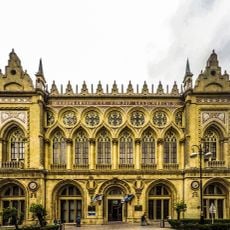
Baku Fortress Wall, Medieval fortress in Baku, Azerbaijan
Baku Fortress Wall is a medieval defensive structure that surrounds the historic center of the city and consists of stone blocks preserved in several sections. The structure features two defensive rows with varying heights and widths that controlled access to the settlement.
The wall was built in the first half of the 12th century under Shirvanshah Manuchehr III (1120–1160), as recorded on a Kufic inscription found in 1954 and now kept in the Museum of History of Azerbaijan. In 1608/9, under Shah Abbas I, Zulfiqar Khan had an outer wall built, as stated on a gate inscription dated 1017 AH. The outer wall was demolished between 1883 and 1888, and the Zulfiqar Khan gate was moved beside the Shamakhi Gate, forming the Double Gates (Gosha Gala Gapsy).
The wall shapes the character of the Old City and shows how the settlement protected its residents across the centuries. The visible stone blocks and bastions speak to the place's importance as a defense line against attacks from sea and land.
The preserved wall sections can be explored on foot and offer different vantage points of the Old City and its surroundings. The best time to visit is early morning or late afternoon, when shadows highlight the structures better.
The main defence tower, a rectangular keep called Cəbbəxana (arsenal) in folk etymology, stands in the northern part of Icherisheher. Unlike most keeps, it was built into the line of the wall rather than at the city centre, reinforcing the curtain. Of the 70 semicircular fighting towers recorded in medieval sources, 25 survive.
The community of curious travelers
AroundUs brings together thousands of curated places, local tips, and hidden gems, enriched daily by 93,364 contributors worldwide.