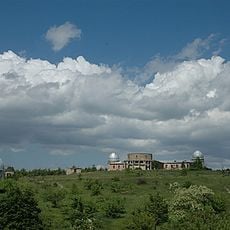
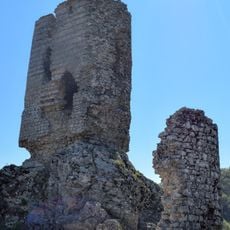
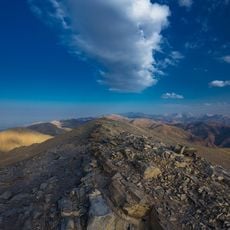
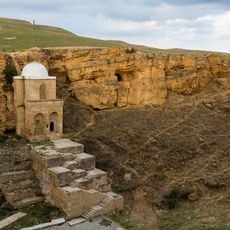
Gilgilçay barrier, Ancient defensive wall in Siyazan, Azerbaijan.
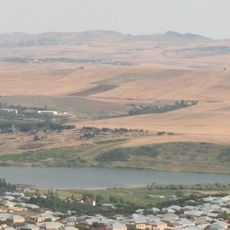
The Gilgilçay barrier is a Sassanian defensive line running about 50 km from the Caspian shore to the foot of Babadağ. Its walls were built of mud brick and rough stone, with towers every 30–35 m; heights reach 5–7 m near Kolany and 7–11 m in places. The main stronghold was Çıraqqala, a 5th-century fortress on a rock at the line's end.
This fortification was built in the 5th century by the Sassanids to protect northern territories from invasions from the steppes. The structure remained an important defensive point for centuries, controlling access to the region through key mountain and coastal passages.
Arab sources called the barrier Sur at-Tin, the "Clay Wall", after its mud-brick sections. Çıraqqala, its main stronghold, served as a signal post: in peacetime it watched the plain, and in danger its great beacon spread the alarm in all directions.
The ruins are located near Siyazan and can be visited throughout the year without restrictions. Wear comfortable walking shoes as the ground is uneven, and allow time to walk the length of the fortification to get a sense of its full scale.
The barrier's walls were not uniform: a five-kilometre stretch from the Gilgilçay basin to the mountains was built of mud brick, while other sections used rough-hewn stone. Bastions or towers stood every 30 to 35 metres, and from the 85th bastion the line turns southwest, where walls reach 30 m on the lower side and 15 m above.
The community of curious travelers
AroundUs brings together thousands of curated places, local tips, and hidden gems, enriched daily by 93,365 contributors worldwide.