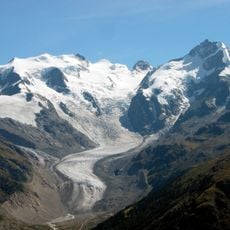
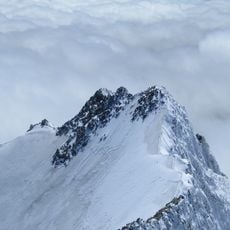
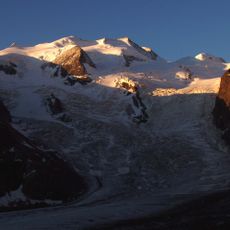
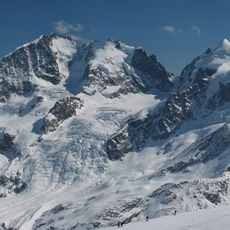
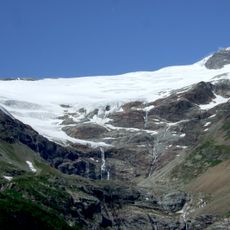
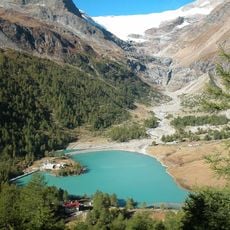
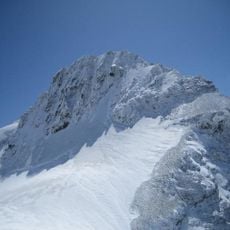
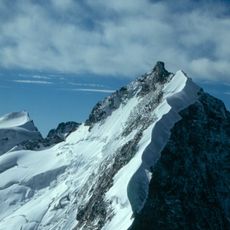
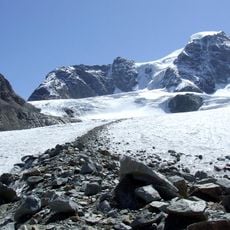
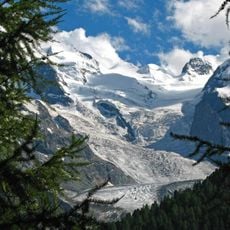
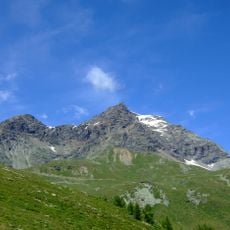
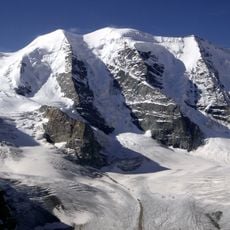
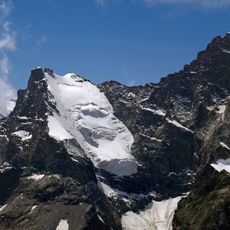
Piz Palü, Alpine peak in Bernina Range, Switzerland and Italy.
Piz Palü is a glaciated massif in the Bernina Range on the Swiss-Italian border, with three summits on an east-west ridge: Piz Spinas (3,823 m), the central Muot dal Palü (3,899 m) and Piz Palü Orientale (3,882 m). Its north face holds four hanging glaciers separated by three rock pillars above the Pers Glacier; the main summit lies entirely in Graubünden.
The first documented ascent to the central summit took place in 1866 when Kenelm Edward Digby climbed it with guide Peter Jenny and a porter. This early achievement marked the beginning of mountaineering exploration on this Alpine terrain.
Piz Palü appears in the 1929 film The White Hell of Pitz Palu, co-directed by mountain-film pioneer Arnold Fanck and Georg Wilhelm Pabst, with a young Leni Riefenstahl in the cast. It is a feature film, not a documentary. The title borrowed the mountain's name for a fictional drama set in winter alpine terrain.
The normal route leaves Diavolezza via the crevassed Pers Glacier to the east ridge shoulder, then follows an exposed snow edge to the east and main summits; allow four to five hours to the central peak. The route is rated WS on the SAC scale, but blank ice and hidden crevasses call for rope, crampons and full glacier kit. Ski tourers usually leave skis on the east ridge and climb the final crest in crampons.
The name Palü comes from Latin palus, swamp, taken from Alpe Palü, a pasture on marshy ground 4 km east; the mountain inherited the name. The common reading "pale mountain" is mostly rejected. The 3,899 m main summit lies entirely on Swiss soil, while the border runs about 100 m west of it at 3,898 m.
The community of curious travelers
AroundUs brings together thousands of curated places, local tips, and hidden gems, enriched daily by 92,745 contributors worldwide.