Klein Matterhorn, Mountain summit in Zermatt, Valais, Switzerland
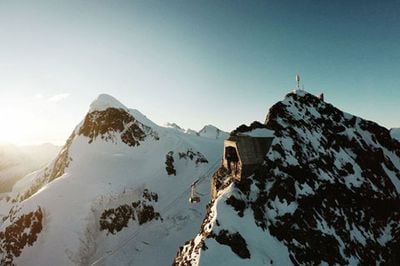
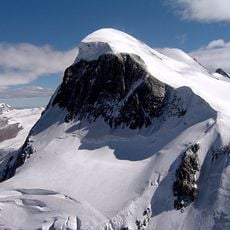
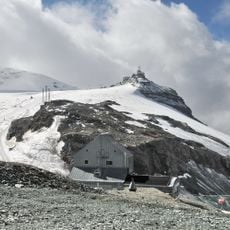
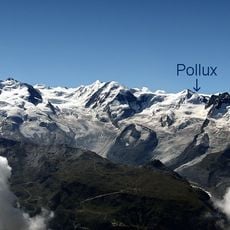
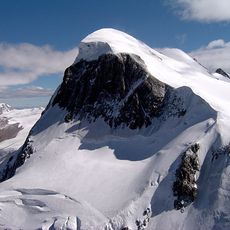
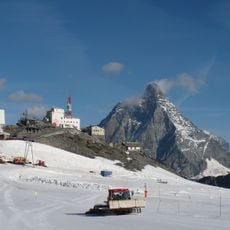
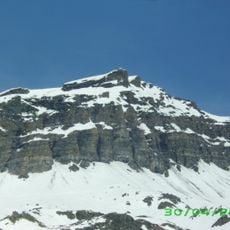
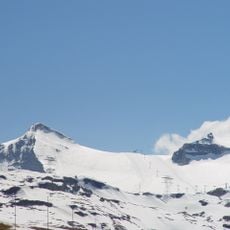
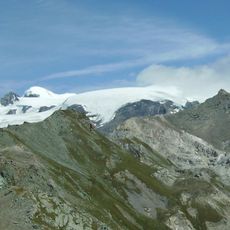
Klein Matterhorn is a 3,883-metre peak at the western end of the chain running from Monte Rosa toward the Theodul Pass, separated from the Matterhorn by that pass. Its upper part is bare black and brown rock, steep and jagged, with a pointed summit; below it, snow fills gullies and broad slopes, and a glacier's textured surface shows on the left flank. Two metal lattice towers carrying cables stand on the snow-covered slope in front of the peak.
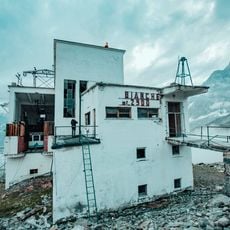
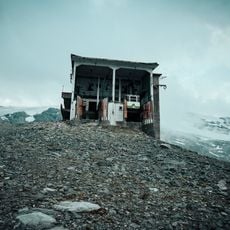
The cable car to the Klein Matterhorn was approved by the Federal Council on 17 December 1973 after objections from environmentalists and a complaint by Zermatt citizens. Construction began in August 1976; concrete for the 3,820 m station was flown in by helicopter, and 35.8 km of cables were dragged up in summer 1977. The Von Roll lift opened on 23 December 1979, making the summit the highest point in Europe reachable by cable car.
The name Klein Matterhorn refers to the Matterhorn, 7 km away across the Theodul Pass; the peak is also called Petit Cervin in French, Piccolo Cervino in Italian and Little Matterhorn in English. Since 23 December 1979 a cable car from Zermatt has made the summit a year-round destination, marketed as "Matterhorn Glacier Paradise".
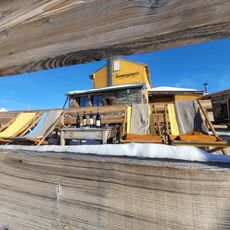
The summit is reached through a chain of cable car systems starting from the village below, with a final platform at the peak for viewing. These transport lines operate throughout the year, making high-altitude access manageable for most visitors.
The cable car's longest span, 2,885 m between the last tower and the top station, is the longest in Switzerland; cabins lose height after the last tower before climbing to the station. The 1976-79 construction used 2,000 m³ of concrete flown up by helicopter, mixed with warm water and 2% anti-freeze.
The community of curious travelers
AroundUs brings together thousands of curated places, local tips, and hidden gems, enriched daily by 92,616 contributors worldwide.