Guangdong TV Tower, Steel television tower on Yuexiu Hill, Guangzhou, China
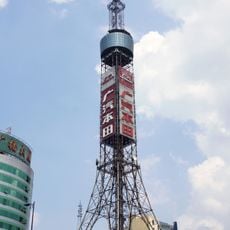
Guangdong TV Tower is a 200-metre steel lattice television tower on the northern peak of Yuexiu Hill in Guangzhou's Yuexiu Park. Built in 1959 and in service since 1 May 1966, it was China's first self-supporting steel television tower. It has five work platforms totalling 226 square metres, and two former viewing platforms at 50.6 and 98.4 metres.
Planning began in 1959, when Guangdong radio authorities sought a permanent tower to expand television coverage; after proposals for Baiyun Mountain and the Aiqun Hotel were rejected, the city approved a site on Panlonggang, a small hill on Yuexiu Mountain's north peak. Designed by Beijing's Metal Structure Research and Design Institute and built with a steel lattice, the 200 m tower entered service on 1 May 1966 as China's first self-supporting steel television tower. It was long a Guangzhou landmark and, in the 1970s, the country's tallest tower.
The tower's name is also given as Yuexiu Mountain TV Tower, after its site on the north peak of Yuexiu Hill. Its two former viewing platforms were named Yunxiao Ge (98 m) and Xinghe Zuo (50.6 m), the latter fitted with over 140 seats and star-like ceiling lights. Ren Zhongyi, then Guangdong party secretary, inscribed the phrase "Stand high, see far" after a visit.
The tower stands on the northern peak of Yuexiu Hill inside Yuexiu Park, at 246.5 m above sea level; the nearest metro stops are Yuexiu Park (Line 2) and Xiaobei (Line 5). Its two sightseeing platforms, the 420 m² Xinghe Hall at 50.6 m and the 170 m² Yunxiao Pavilion at 98.4 m, closed to visitors in 2000 after the Ostankino fire, so the structure is viewed from outside. A bus stop named after the tower serves the park.
The tower's 50.6 m and 98.4 m levels once held two sightseeing platforms: the 420 m² Xinghe Zuo hall with over 140 seats and star-shaped ceiling lights, and the 170 m² Yunxiao Ge, fitted with a 20-power telescope for visitors. Both opened on 4 February 1986 as a cultural amusement centre; Ren Zhongyi, then Guangdong party secretary, visited and wrote "Stand high, see far". Sightseeing ended in 2000 after the Ostankino tower fire in Moscow prompted safety concerns.
The community of curious travelers
AroundUs brings together thousands of curated places, local tips, and hidden gems, enriched daily by 92,790 contributors worldwide.