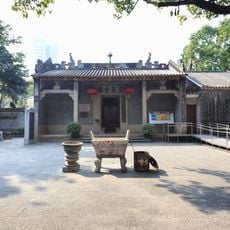
四方炮台, Military fortification in Guangzhou, China
The Sifang Battery, originally Yongning Battery, sits on the summit of Panlong Hill in Yuexiu, Guangzhou. Built in 1653, it is a square fortification about 48 metres long and wide and 7 metres high, divided into an outer platform and an inner platform. Only its foundations remain today.
Built in 1653 under the Shunzhi emperor as the Yongning Battery, the square-plan fort on Panlong Hill became known as Sifang. On 25 May 1841, during the First Opium War, British troops seized it as their headquarters and withdrew after the Treaty of Guangzhou. On 31 May local peasants from Sanyuanli surrounded the fort but were persuaded to disperse by the Qing authorities. It was damaged in the Second Opium War.
The site shows how defenders once organized their weapons to control access from the water. Stone walls and gun positions follow patterns that were common in Chinese military design of the period.
The site sits on the top of Panlong Hill on Yuexiu Mountain, not by the river; only the fort's foundations remain, so there are no raised platforms to climb. The ground is uneven, and the iron cannon found here in 1962 is not on site but in the Guangdong Revolutionary History Museum.
The cannons were arranged on platforms at different heights to hit ships at varying distances from the water. This layered setup shows a practical approach to controlling the broad river.
The community of curious travelers
AroundUs brings together thousands of curated places, local tips, and hidden gems, enriched daily by 93,861 contributors worldwide.