Mount Li, Mountain summit in Lintong District, China.
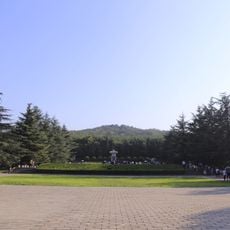
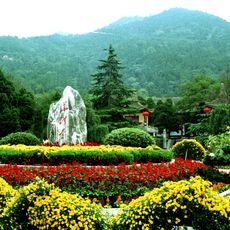
Mount Li is a summit within the Qinling mountain range rising 1,302 meters, located in Shaanxi Province. The peak sits above a vast area that has hosted human activity for thousands of years, from ancient empires to modern times.
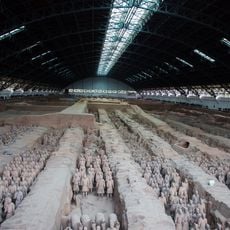
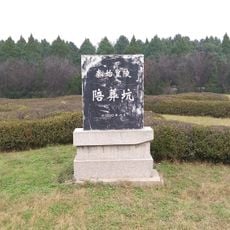
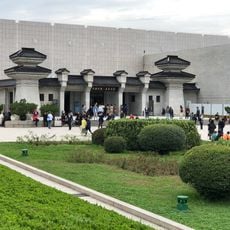
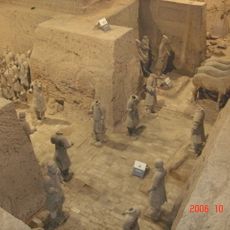
The base of this mountain was chosen by Emperor Qin Shi Huang to build his mausoleum complex, containing the famous Terracotta Warriors created around 210 BCE. The burial site became one of China's most significant archaeological discoveries when excavated in modern times.
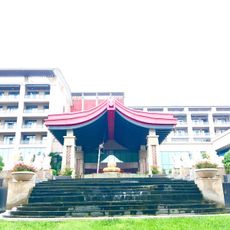
The mountain is worshipped as the place where the goddesses Lishan Laomu and Nüwa repaired the wall of heaven, and both have long been honoured here. Its name, "Black Steed Mountain", is variously traced to a horse-like profile or to the Black Steed Tribe of the Shang and Zhou. The pavilion on the slope, built in 1946 with funds from Whampoa Military Academy students, was renamed Bingjian Pavilion in 1986.
The climbing route passes the beacon tower, Laomu Hall, Laojun Hall and Bingjian Pavilion, the last marking the crevice where Chiang Kai-shek was found in 1936. Li Mountain National Forest Park is a national-level protected site and an AAAA-rated attraction. The summit stands at 1,302 metres, so allow time for the ascent.
The pavilion on the slope commemorates the December 1936 Xi'an Incident, when Chiang Kai-shek was found hiding in a crevice on Mount Li. Built as the Minzu Fuxing Pavilion, rebuilt in steel and concrete in 1946 with funds from Whampoa Military Academy students, it was renamed Zhengqi Pavilion, then Seizing Chiang Pavilion, and took its present name, Bingjian Pavilion, in 1986.
The community of curious travelers
AroundUs brings together thousands of curated places, local tips, and hidden gems, enriched daily by 92,784 contributors worldwide.