Yuling Mausoleum, Imperial mausoleum in Zunhua, China
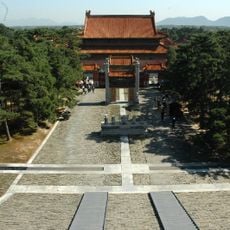
Yuling Mausoleum is the burial complex of Emperor Qianlong in the Eastern Qing Tombs at Zunhua. Its single-storey halls with yellow-orange glazed tile roofs and red walls stand on a raised stone platform behind a white marble balustrade, with arched bridges descending to a worn stone-paved court. A taller double-eaved hall rises left of centre, and the underground palace lies beneath the earthen mound.
Construction began in 1743, the eighth year of Qianlong's reign, at Shengshuiyu west of the Xiaoling tomb, and the main works were finished in 1752 at a cost of over 1.7 million taels of silver. In 1928 the warlord Sun Dianying had his troops surround and dig into the tomb, using explosives on the fourth stone gate; water seeped in badly afterwards. When the underground palace was examined in 1974 it was flooded, the coffins floated, and all grave goods had been stolen.
The burial chambers show Buddhist figures and religious writings in different alphabets that speak of the faith practiced at the imperial court. Visitors walk through rooms where stone reliefs and sacred formulas remain.
The site lies east of Beijing in a wide area that holds several imperial tombs and is connected by paved paths. Visitors should wear comfortable shoes, as the underground chambers are reached by stairs and the grounds have gentle slopes.
The underground chambers were partly restored after the raid, but many original objects and decorations remain missing to this day. Visitors therefore see a burial site that shows both its former splendor and the traces of looting.
The community of curious travelers
AroundUs brings together thousands of curated places, local tips, and hidden gems, enriched daily by 92,780 contributors worldwide.